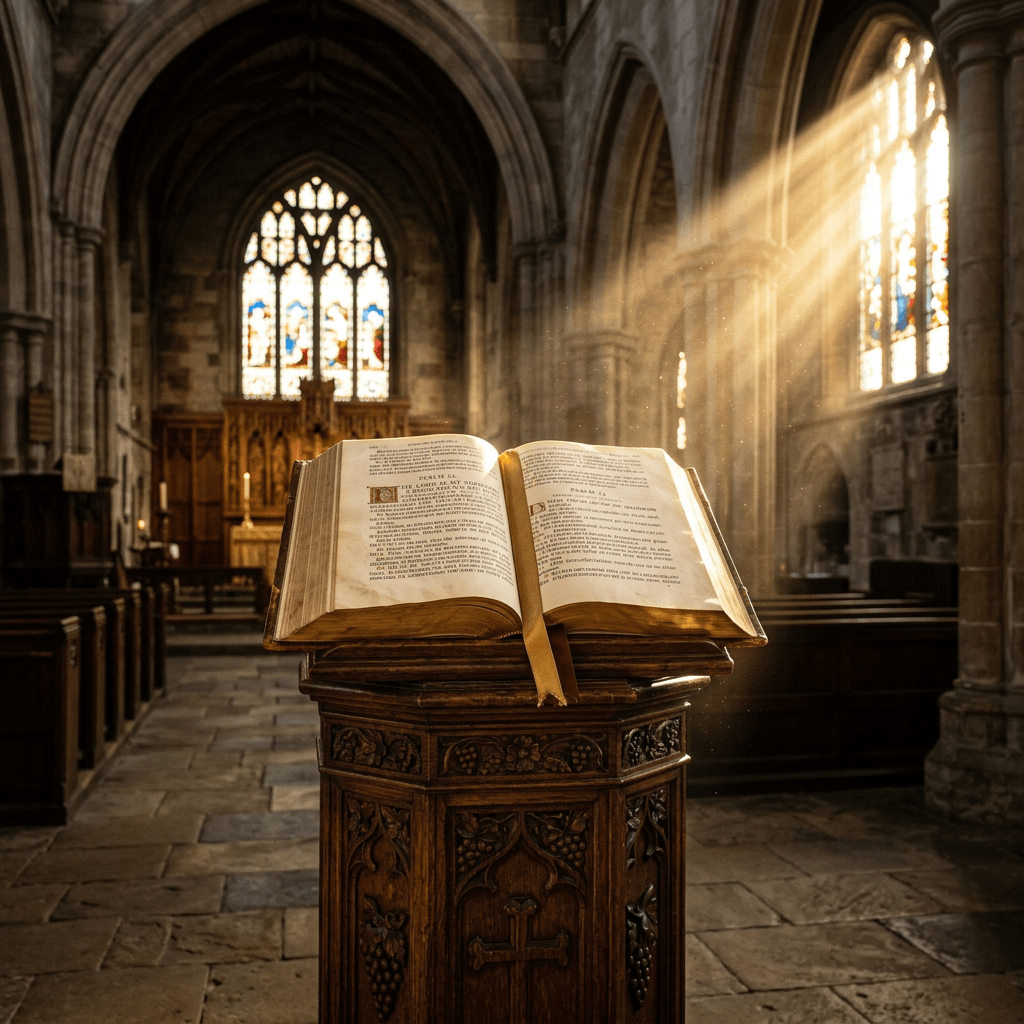
We just had ‘week two’ at church in a series on ‘What We Believe’, and this week was all about why we confidently believe that the Bible we hold in our hands today is a reliable copy of the original writings, and that it is the supernatural Word of God that carries the highest authority in the land. This has been the position of the Church since its beginning, and the Creed we’re using is part of that legacy as the Church laboured over many of the doctrines and truths we hold today.
Below is a short Study Guide for those who want to take a slower, deeper dive into this week’s topic.
The Apostle’s Creed
I believe in God, the Father almighty,
creator of heaven and earth.I believe in Jesus Christ, his only Son, our Lord,
who was conceived by the Holy Spirit,
born of the Virgin Mary,
suffered under Pontius Pilate,
was crucified, died, and was buried;
he descended to the dead.
On the third day he rose again;
he ascended into heaven,
he is seated at the right hand of the Father,
and he will come to judge the living and the dead.I believe in the Holy Spirit,
the holy catholic Church,
the communion of saints,
the forgiveness of sins,
the resurrection of the body,
and the life everlasting.
Amen.
Week Two’s Creed Anchor: “…suffered under Pontius Pilate, was crucified, died, and was buried…”
Notice something easy to miss in the Creed: it names a date. Pontius Pilate was a real Roman governor, in a real province, at a real time. The Christian faith is not a collection of timeless spiritual feelings; it makes claims about things that actually happened, in history, recorded in a book. Which raises the question this week answers: can we trust the book? Where do we turn for truth, and why would we stake our lives on Scripture rather than on our own opinions, the latest podcast, or the mood of the culture? This guide takes the Sunday message further: not just that the Bible is God’s Word, but how we know it, how it has reached us intact, and how to answer the friend who says it cannot be trusted.
1. The big question: Where do you turn for Truth?
Every single day, you decide what to believe is true, and you act on it. The question is never whether you will trust some authority; it is which authority you will trust. Your own reason and education? The media, or the influencer with the most confident voice? Whatever your friends and family assume? The trouble is that every one of those authorities is finite, changeable, and frequently wrong, including, if we are honest, our own hearts. As the prophet Jeremiah warned, “the heart is deceitful above all things” (Jeremiah 17:9); an uncomfortable thing to remember in an age that tells us to follow it.
Christians make a startling claim: that there is an authority above all the others, one that does not shift with the culture or the decade, because it comes from outside the system altogether. We believe God has spoken, and that his speech is written down for us in the Bible. Not “my truth” or “your truth”, not truth as a feeling, but the truth, objective and binding, because it is God’s.
This is what the Reformers, five hundred years ago, called sola scriptura, “Scripture alone”: the conviction that the Bible is the final, supreme authority for what Christians believe and how they live, standing over every tradition, council, leader, and personal hunch. Notice the careful word: final, not only. Tradition, teachers, and reason all have their place; but when they conflict with Scripture, Scripture wins, every time. As R. C. Sproul liked to point out, the Reformers did not say Scripture was the only authority, but the only authority that cannot err.[^2]
2. Key terms (kept simple)
Revelation. God showing us what we could never have worked out on our own. General revelation is what God shows everyone through creation and conscience (Psalm 19:1; Romans 1:20). Special revelation is God’s specific, saving speech, supremely in Scripture and in Christ.
Inspiration. Not “inspiring” the way a sunset or a song inspires you. The Bible’s claim is that God so superintended the human authors that what they wrote is what he wanted written. The Greek word in 2 Timothy 3:16 is theopneustos, literally “God-breathed.”
Inerrancy. The teaching that Scripture, in its original writings, tells the truth and does not mislead us in anything it affirms. (More on what this does and does not mean below.)
Infallibility. The closely related teaching that Scripture cannot fail in its purpose; it is a completely trustworthy guide.
Canon. From a Greek word for “measuring rod”. The list of books the church recognised as Scripture, 66 in our Bibles. The church did not create the canon so much as recognise the books that already carried God’s authority, the way you recognise, rather than invent, the sun.
Manuscript. A handwritten copy. We have no “original” of any biblical book (the autographs), only copies, which is exactly why the science of comparing them matters.
Textual criticism. The careful, painstaking work of comparing the thousands of surviving manuscripts to establish what the originals said. The word “criticism” here does not mean “criticising” the Bible; it means scholarly analysis, much like an art expert authenticating a painting.
3. Into the text: what the Bible says about the Bible
We have to be careful here, and honest. Yes, the Bible claims to be God’s Word, and we should look at those claims; but the case does not rest on the Bible simply asserting its own authority in a circle. We will look at the historical evidence too (Section 5). First, though, what does Scripture actually claim for itself?
It is God-breathed and useful: 2 Timothy 3:16-17
“All Scripture is breathed out by God and profitable for teaching, for reproof, for correction, and for training in righteousness, that the man of God may be complete, equipped for every good work.” (ESV)[^3]
Two things leap out. First, the source: “breathed out by God”. Scripture does not merely contain God’s word here and there; it is God’s word, down to its origin. Second, the purpose: it is given to change us, to teach, correct, and train us into maturity. The Bible is not an end in itself, a trophy of right doctrine; it is the means by which God matures his people and equips them for a life of good works. Sixty-six books, written by more than forty authors across roughly 1,500 years, on three continents, in three languages, by kings and shepherds and fishermen and a doctor, and yet it tells one unfolding story with one consistent message and one central figure. No committee could have planned that. Only one Divine author could.
Human Authors Carried Along by the Spirit: 2 Peter 1:20-21
“...no prophecy of Scripture comes from someone’s own interpretation. For no prophecy was ever produced by the will of man, but men spoke from God as they were carried along by the Holy Spirit.” (ESV)[^4]
This verse answers the natural question, “inspired by God, but written by men, how does that work?” Peter’s picture is beautiful: the human authors were “carried along” by the Spirit. The Greek word (pheromenoi) is the same one used in Acts 27 for a ship carried along by the wind.[^5] The sailors still steered, the wind still drove; the ship went where the wind took it. So with Scripture: God did not dictate to robots, bypassing the writers’ minds. He worked through their personalities, vocabularies, and styles, which is why you can tell Paul’s dense arguments from John’s simple profundity or Luke’s careful history, and yet through all of them it is God speaking his perfect Word. This is sometimes called the doctrine of concursive inspiration: fully divine and fully human at once, a little like the One the book is ultimately about.
Living and active: Hebrews 4:12-13
“For the word of God is living and active, sharper than any two-edged sword, piercing to the division of soul and of spirit… and
discerning the thoughts and intentions of the heart.” (ESV)[^6]
Ever felt as though the Bible was reading you? That is not your imagination. Scripture is not inert ink on a page or pixels on a screen; it is “living and active”. When you open it, you are not merely studying an ancient text; the living God is addressing you, exposing you, healing you, drawing you to himself. This is why a verse you have read a hundred times can suddenly cut to the centre of your life on the hundred-and-first.
4. What Inerrancy Does and Does Not Mean
The word inerrancy can be a confusing thing, but it doesn’t need to be.
In 1978, hundreds of evangelical leaders gathered in Chicago and produced the Chicago Statement on Biblical Inerrancy, still the clearest summary we have.[^7] Here is what it carefully affirms, in plain terms.
Inerrancy applies to what Scripture actually affirms, read the way the author meant it.
So when the Bible uses poetry, it means it as poetry; when it rounds a number, it is not “lying”; when it describes the sun “rising”, it is using ordinary speech, just as your weather app does. Inerrancy is not the same as wooden literalism. The Bible contains history, poetry, parable, prophecy, and letters, and each is true in the way that kind of writing is meant to be true.
Inerrancy strictly applies to the original manuscripts (the autographs), not to every copy or translation. Does that undercut us, since we do not have the originals? Not at all, and this is the reassuring part. The Chicago Statement notes that the original text “can be ascertained from available manuscripts with great accuracy”, and that no essential teaching of the faith is in doubt because of the tiny uncertainties that remain.[^8] Which brings us to the evidence.
5. Hasn’t the Bible been Changed? The Manuscript Evidence
This is the objection you will hear most: “The Bible has been copied and translated so many times, it is like a game of telephone; who knows what the originals even said?” It sounds devastating. It is also, happily, the easiest objection to answer, because the evidence runs strongly the other way.
The New Testament is the best-attested document of the ancient world, by a long shot. We possess somewhere around 5,800 Greek manuscripts of the New Testament, plus thousands more in Latin and other ancient languages, some fragments dating to within a generation or two of the originals. Compare that with other ancient texts nobody doubts: most classical works survive in only a handful or a few dozen copies, the earliest often made many centuries after the author died. By any fair standard applied to ancient literature, the New Testament is in a league of its own.
More copies means more certainty, not less. This is the part the “telephone” picture gets backwards (or as we Aussies used to call it, Chinese Whispers). In the children’s game, there is one chain and no way to check it. With the New Testament, we have thousands of independent copies made in different places and times; when we lay them side by side, the differences (called “variants”) light up immediately, and the overwhelming majority are trivial, spelling slips, a word order swapped, an obvious scribal hiccup. Where a meaningful variant exists, it is openly footnoted in your Bible (think of the note at John 7:53 to 8:11, or the longer ending of Mark). Nothing is hidden. And crucially, no Christian doctrine hangs on a disputed reading. The scholar Daniel Wallace, who has spent his life cataloguing these manuscripts, makes exactly this point: the sheer volume of evidence lets us reconstruct the original text with very high confidence.[^9]
The Old Testament got a stunning confirmation in 1947. Before then, our oldest complete Hebrew Old Testament manuscripts dated to around the tenth century AD. Then a shepherd boy stumbled into a cave near the Dead Sea and found scrolls a thousand years older. When scholars compared the Great Isaiah Scroll with the medieval copies, the text had been preserved with remarkable fidelity across that vast gulf of time. The scribes had done their job, faithfully, for a thousand years.
On “a translation of a translation”. Modern translations like the ESV are not made from a chain of earlier English Bibles. They are translated directly from the Hebrew and Greek, by committees of scholars working from the best manuscripts we have. (This, incidentally, is why “translation philosophy” matters so much, and why a one-man paraphrase that pads the text out should never be confused with a real translation.) If you want to dig into all of this at a popular level, the Canadian scholar Wesley Huff has produced an excellent, free, and very watchable documentary series, Can I Trust the Bible?, walking through manuscripts, the canon, and the “Council of Nicaea invented it” myth.[^10] Side note: Bible ‘translations’ to avoid include: The Mirror Bible, The New World Translation, and The Passion Translation; these are considered spurious and misleading by all leading Biblical Scholars, and by all academic and theological standards. If you want a good paraphrase, go with The Message, a good ‘easy to read’ try the NLT or NIV, or for a more literal translation closer to the text, go with the ESV, RSV or NJKV.
Want to get emailed when new articles get published? Sign up below.
6. Where did the 66 books Come From? A Word on the Canon
Who decided which books made it in, and were good ones left out? You may have heard about “lost gospels” like the Gospel of Thomas (not actually written by Thomas).
The short answer is that the church recognised the canon rather than voting it into being. The books that were received were those with a genuine connection to Jesus and the apostles, written within the apostolic era, consistent with the faith handed down, and used and acknowledged across the churches. The so-called “lost gospels” (the Gnostic texts found at Nag Hammadi, for example) were written much later, often a century or more after the events, and teach a different religion altogether; they were not so much “banned” as never genuinely in the running. The four Gospels we have were already being treated as a settled set remarkably early.
The disagreement between Protestants and Roman Catholics over the Apocrypha (a handful of Old Testament-era books like Maccabees) is a real but limited one, and it concerns those few books, not the Gospels or the New Testament, which all sides receive. Our own conviction, with the Reformers, is that those additional books are valuable history but not Scripture, and were not part of the Hebrew canon Jesus himself used.
7. Common Objections and Misconceptions
“The Bible is full of contradictions.” This attack usually turns out to mean “I have heard there are some.” When you actually examine the famous examples, the great majority dissolve on a closer reading: different authors emphasising different details of the same event (as four honest witnesses to a car accident would), rounded numbers, or our own failure to read the genre rightly. A handful are genuinely difficult, and mature faith is willing to sit with a hard question rather than pretend it does not exist. But “I cannot yet harmonise this” is a very different statement from “this is a proven error”, and the track record of supposed “errors” being resolved by better historical and linguistic understanding should make us patient.
“It was written by men, so it is just a human book.” Yes, and no. It was genuinely written by men (2 Peter 1:21), with all their humanity intact, and it was breathed out by God (2 Timothy 3:16). Insisting it must be either divine or human is like insisting Jesus must be either God or man. The Christian answer in both cases is both, and fully.
“You only believe it because you were raised to, OR, it is circular to use the Bible to prove the Bible.” Two responses. First, the case for trusting Scripture is not purely circular; it rests partly on public, checkable evidence, the manuscripts, the archaeology, the fulfilled prophecy, the historical reliability of the Gospels, the resurrection. Second, everyone reasons from some ultimate authority they did not first “prove” from the outside (the atheist trusts human reason to evaluate human reason). The question is not whether you have an ultimate authority, but whether yours can bear the weight. Ours has borne it for millennia.
“Even if it is reliable, it is ancient and irrelevant to my life.” Hebrews 4:12 is the standing rebuttal. The God who spoke is the God who still speaks through these words. People in every century have found the Bible to be the one book that, instead of going out of date, keeps reading them.
8. So How Should We Treat the Bible?
If all this is true, it has consequences for how we actually live with our Bibles.
This is perhaps the most important point.
Do not bypass it, and do not skip the hard parts.
The temptation is to quietly avoid the passages our culture finds offensive; the ones about money, sex, gender, marriage, judgement, self-denial. But if Scripture is God’s authoritative Word, then we come to it first on every matter and let it shape us, even when that means standing against the spirit of the age, denying ourselves, or opting out of whatever is trending.
Don’t bypass Scripture when it gets uncomfortable; lean in.
I’ve written about this specific issue in more detail here (and I think it’s definitely worth a read).
The alternative is to sit in judgement over the Bible, keeping the bits we like, which is just to make ourselves the authority again. The very first sin worked exactly that way: Adam and Eve set aside the clear word God had given them and trusted a different voice instead (Genesis 3), and the result was decay, death, and a world needing rescue. They still trusted a voice, and an authority; they still believed a word, but it was the wrong one; it was a lie. God’s Word is Truth.
But do not stop at information, either. Here is the soberest warning of all, and it should keep us humble. Satan knows the Bible; he quoted it accurately to Jesus in the wilderness (Matthew 4), and it did not save him. The Pharisees knew the Scriptures inside out, and Jesus told them they had missed the entire point: “you search the Scriptures because you think that in them you have eternal life; and it is they that bear witness about me, yet you refuse to come to me” (John 5:39-40).
It is possible to master the text and miss the Lord. The goal of all Bible study is not to win arguments or to know more than your neighbour; it is to meet, know, and love the Christ to whom every page points. As Jesus said, his sheep know his voice (John 10:27), and we come to know that voice by living in his Word.
So, read it to meet him. Study it rigorously, yes; yet study it with confidence and expectation that you will meet with God and be transformed by His kindness as you yield to his view of reality.
9. A week of daily readings
Day 1. God-breathed. Read 2 Timothy 3:10-17. Thought: Scripture’s origin (God-breathed) and its goal (to mature and equip you) belong together. It is not given to inform you but to transform you. Question: Which part of your life are you least willing to let Scripture “correct” or “train”? Why?
Day 2. How God spoke. Read 2 Peter 1:16-21. Thought: Peter insists the apostles did not follow “cleverly devised myths” but were eyewitnesses, and that Scripture came as men were “carried along” by the Spirit. Question: Does it change anything for you to know the Bible is grounded in eyewitness history, not religious legend?
Day 3. Living and active. Read Hebrews 4:12-16. Thought: The same Word that exposes us also points us to a sympathetic High Priest at the throne of grace. Conviction and comfort come together. Question: When has the Bible most recently “read you”, exposing something you had not seen?
Day 4. Knowing the book but missing the Lord. Read John 5:39-47 and Matthew 4:1-11. Thought: Both the devil and the Pharisees knew the Scriptures. Knowledge is not the same as life. The text exists to bring us to Christ. Question: Is your Bible reading drawing you closer to Jesus himself, or has it quietly become a box to tick?
Day 5. Hidden treasure. Read Psalm 19 and Psalm 119:9-16. Thought: The Bible’s own songs treat God’s Word as sweeter than honey and more precious than gold. Delight, not just duty. Question: What would it look like this week to treasure Scripture rather than merely consume it?
10. Small group discussion questions
- Be honest: what authorities do you actually turn to first when deciding what is true (gut, Google, a particular voice you
follow)? How does sola scriptura challenge that? - Read 2 Timothy 3:16-17 together. If Scripture is given to “equip” us for “every good work”, how should that shape the way we read it,
not just whether we read it? - The “telephone game” objection sounds strong until you learn how manuscripts actually work. After reading Section 5, how would you
now answer a sceptical friend in two or three sentences? - Why does it matter that the church recognised the canon rather than invented it? What difference does that distinction make?
- Which passages of Scripture does our culture find most offensive right now? What makes it hard to “not bypass” them, and what would
faithfulness look like? - Satan and the Pharisees both knew the Bible. What is the difference between knowing the text and knowing the Lord, and how
do you tell which you are doing? - Application: Name one concrete change to how you will handle your Bible this week, whether in how much, how, or *with what
heart* you read it.
11. Going further
- R. C. Sproul, Knowing Scripture (IVP). The classic short guide to reading the Bible well. See also Ligonier’s free resources on Scripture at ligonier.org.
- The Chicago Statement on Biblical Inerrancy (1978). Read the full statement free at Ligonier; short, clear, and the standard reference point.
- Wesley Huff and Andy Steiger, Can I Trust the Bible? A free documentary series on manuscripts, the canon, and the Nicaea myth, via wesleyhuff.com.
- F. F. Bruce, The New Testament Documents: Are They Reliable? The accessible classic on the historical evidence.
- Greg Gilbert, Why Trust the Bible? (Crossway / 9Marks). A brief, warm, layperson-friendly walk-through of the very questions in this guide.
- Desiring God, “Why I Trust the Scriptures” by John Piper, on the inner testimony of the Spirit alongside the external evidence.
Select bibliography
Bruce, F. F. The New Testament Documents: Are They Reliable? 6th edn.
Grand Rapids, MI: Eerdmans, 1981.
Danker, Frederick William, ed. *A Greek-English Lexicon of the New
Testament and Other Early Christian Literature* (BDAG). 3rd edn.
Chicago: University of Chicago Press, 2000.
Gilbert, Greg. Why Trust the Bible? Wheaton, IL: Crossway, 2015.
Huff, Wesley, and Andy Steiger. Can I Trust the Bible? Apologetics
Canada, 2024. https://www.wesleyhuff.com/can-i-trust-the-bible.
Sproul, R. C. Knowing Scripture. Downers Grove, IL: InterVarsity
Press, 1977.
Sproul, R. C. Scripture Alone: The Evangelical Doctrine. Phillipsburg,
NJ: P&R, 2005.
Wallace, Daniel B., ed. *Revisiting the Corruption of the New
Testament*. Grand Rapids, MI: Kregel, 2011.
The Chicago Statement on Biblical Inerrancy. International Council on
Biblical Inerrancy, 1978.
https://learn.ligonier.org/articles/chicago-statement.
[^1]: Scripture quotations are from *The Holy Bible, English Standard
Version* (Wheaton, IL: Crossway, 2016) unless marked NLT, *Holy
Bible, New Living Translation* (Carol Stream, IL: Tyndale House,
2015). Passage links go to Bible Gateway.
[^2]: On sola scriptura as the final, not the only, authority,
see R. C. Sproul, Scripture Alone: The Evangelical Doctrine
(Phillipsburg, NJ: P&R, 2005); and the free overview at
ligonier.org.
[^3]: Read the passage at Bible Gateway (ESV) and (NLT).
[^4]: Read the passage at Bible Gateway (ESV).
[^5]: Frederick William Danker (ed.), *A Greek-English Lexicon of the
New Testament and Other Early Christian Literature* (BDAG), 3rd edn
(Chicago: University of Chicago Press, 2000), s.v. “φέρω”, which
covers the sense “to be moved or carried along” used in both 2 Peter
1:21 and Acts 27:15, 17.
[^6]: Read the passage at Bible Gateway (ESV).
[^7]: The Chicago Statement on Biblical Inerrancy (International
Council on Biblical Inerrancy, 1978). Full text free at Ligonier
(accessed 31 May 2026).
[^8]: Chicago Statement, Article X (as above).
[^9]: Daniel B. Wallace, who founded the Center for the Study of New
Testament Manuscripts, makes this point in numerous lectures and in
Daniel B. Wallace (ed.), *Revisiting the Corruption of the New
Testament* (Grand Rapids, MI: Kregel, 2011). The figure of roughly
5,800 Greek New Testament manuscripts is the commonly cited count.
[^10]: Wesley Huff and Andy Steiger, Can I Trust the Bible?
(Apologetics Canada, 2024); freely available via wesleyhuff.com
(accessed 31 May 2026).
Discover more from Seeds & Streams
Subscribe to get the latest posts sent to your email.
