The Christian distinctive really is that we believe in ONE God who is revealed in THREE persons. It is based on Scripture; it is right there in the Apostle’s Creed, and it has been a pillar of Christian belief since the church began in the 1st Century. I recently preached a sermon on why we, as Christians, believe in the Trinity. The following is a Study Guide to help you dive deeper into the theme of the Trinity and unpack some of the key components that were only briefly touched upon during my sermon (the audio recording can be found on Hope UC’s website in the next few weeks; I will try to remember to update this with a link once the recording is available).
Not my usual style:
This guide is different to my usual writing style; it’s written to help you study as opposed to my usual writing, which is more like short books and articles. This guide works two ways, and you will get the most out of it by using both.
Firstly: for personal study, there is a five-day reading plan (Section 10) that takes you through the key passages one day at a time, with a thought and a question for each.
Secondly: for small groups, the discussion questions (Section 11) move from what the text says, to what it means, to how it changes us. You do not need to cover every question; choose the ones that fit your people.
A quick word on the tools you will see. The main translation here is the English Standard Version (ESV), a careful word-for-word translation, with the New Living Translation (NLT) alongside it where a plainer rendering helps. Now and then we will check a Greek word against BDAG, the standard scholarly dictionary of New Testament Greek, so that you can cross-check it yourself if you like. Key ideas/words are explained the first time they appear. References are gathered in the footnotes[^1]
One last thing before we start. This is a truth to be enjoyed, not just endured. The triune being of God is not a problem the church has to manage; one writer calls it “the vital oxygen of Christian life and joy.”[^2] So come to it as worship, not merely homework.
The Apostle’s Creed
I believe in God, the Father almighty, creator of heaven and earth.
I believe in Jesus Christ, his only Son, our Lord, who was conceived by the Holy Spirit and born of the Virgin Mary. He suffered under Pontius Pilate, was crucified, died, and was buried; he descended to the grave. The third day he rose again from the dead. He ascended to heaven and is seated at the right hand of God the Father almighty. From there he will come to judge the living and the dead. I believe in the Holy Spirit, the holy catholic church, the communion of saints, the forgiveness of sins, the resurrection of the body, and the life everlasting. Amen.
Creed Anchor: “I believe in God, the Father almighty… in Jesus Christ, his only Son, our Lord… I believe in the Holy Spirit.”
The Creed does not open with you. It opens with God. Before the church says anything about itself, its sin, or its salvation, it is made to say something about the One who simply is. So this is where we begin too: with the question every other belief depends on. Who is the God we believe in? The answer is the most distinctly Christian thing we ever say. He is one God, eternally existing in three persons, Father, Son, and Holy Spirit. He is the Trinity. This guide is here to help you take what was preached on Sunday and go deeper into it during the week, from the milk of “God is three-in-one” to the meat of why, where in Scripture, and so what.
1. Why begin with God?
The twentieth-century pastor A. W. Tozer opened his great little book on God’s character with this provocative sentence: “What comes into our minds when we think about God is the most important thing about us.”[^3]
That is exactly why a series on what we believe has to start here. Everything downstream – how you understand sin, salvation, the church, your own worth, your suffering – flows from what you think God is actually like.
And here is the danger Tozer was warning about. It is easy to drift into a god of our own making, a vague “man upstairs”, a cosmic force, an angry judge or a kindly grandfather who exists mainly to be pleased with us. The Christian gently but firmly refuses to make god in our own image. It does not finally matter how we prefer to imagine God; it matters how he has actually shown himself to be. And the God of the Bible has shown himself to be triune.
That word, Trinity, is not a puzzle the church cooked up to make faith harder. It was not invented at the Council of Nicea; it’s much older than that. ‘Trinity’ is the church’s honest summary of how the one God speaks, acts, and saves all the way through the Bible, from the Spirit of God hovering over the waters on the first page (Genesis 1:2) to the threefold blessing of Father, Son, and Spirit near the end of Paul’s letters (2 Corinthians 13:14).
Nobody invented the doctrine and then went hunting for verses to prop it up. The church read the verses, refused to throw any of them away, and the doctrine is what honesty produced. As the Reformed scholar B. B. Warfield once pictured it, the Old Testament is like a richly furnished room that is dimly lit; the furniture of the Trinity was always there, and the New Testament simply turns the light on.[^4]
It matters enormously that we get this right, because it has been observed many times that those who quietly let go of the Trinity tend, sooner or later, to let go of everything else as well. The deity of Christ, the work of the Spirit, the gospel itself, all of it hangs here. And we cannot know and have intimacy with a God we don’t know. He has made himself known, and we are invited to accept God as He is, not as we would prefer him to be.
2. Key terms (kept simple)
A handful of words might keep coming up when studying the Trinity. Here are some of them in plain English.
Trinity / triune. The word means “tri-unity”, three-in-oneness. You will not find the word Trinity in your Bible, and that bothers some people. But you will not find the words monotheism, incarnation, omnipresent or even Christianity in there either, and we use those happily. The word is just shorthand for a pattern that runs right through Scripture. (The Latin term Trinitas was first used by a North African writer named Tertullian around the year AD 200, long before any council “decided” anything.)[^5]
Essence (or being). The “what-ness” of God: his one divine nature. When we say God is one, this is what we mean. There is one divine essence.
Person. The “who-ness” of God. The Father, the Son, and the Spirit are three distinct persons, three “whos”, not three names for one person, and not three pieces of God. So the whole doctrine fits in one line: one essence, three persons.
Monotheism. Belief in one God. The faith of Israel and the church.
Polytheism. Belief in many gods. The pagan world Israel lived among.
Modalism. This common error (more on it later) is the idea that God is one person who simply wears three “masks” or plays three roles at different times, that God changes ‘mode’ when he acts as either the Father, Son or Spirit.
Perichoresis (perry-ko-REE-sis). A term the early Greek-speaking church used for the way the three persons mutually indwell one another, each fully in the others, without ever blurring into one (compare John 14:10-11). You will sometimes hear it translated “to dance around”, and a lot of moving sermons have been built on its supposed link to our word choreography. Enjoy the picture of intimacy it paints, but hold the word-study loosely; the “dance” meaning presses the roots further than the evidence really allows.[^6] What the word actually guards is the togetherness of the three.
3. Into the text
Doctrine that is not drawn from the Bible is just confident opinion.
So let us slow down over the passages that carry this truth, including a few the Sunday message did not have time to reach.
The one God: Deuteronomy 6:4-5
“Hear, O Israel: The LORD our God, the LORD is one.” (ESV) “Listen, O Israel! The LORD is our God, the LORD alone.” (NLT)[^7]
This is the Shema (from the Hebrew word for “hear”), the heartbeat of Israel’s faith, prayed morning and evening by every devout Jew. In a world stuffed with gods, it was a thunderclap: there is one God.
You may hear it argued that the Hebrew word for “one” here, echad, secretly means a “compound unity” (because the same word describes evening and morning becoming one day, and a man and wife becoming “one flesh”), and that the Shema therefore proves the Trinity all by itself. Be careful. Echad is just the ordinary Hebrew word for “one”; whether it points to a simple unit or a unity-of-parts depends entirely on the sentence, not the word.[^8] We do not need to over-reach. The straightforward reading is actually stronger: the Shema insists there is only one God, full stop. It does not yet open up the inner life of that one God. The New Testament does that, never adding a second or third god, but revealing that the one God of the Shema has always been Father, Son, and Spirit. This is what is often called ‘progressive revelation’, not because it’s new and ‘progressive’, but because the revelation of God builds upon previous revelations and becomes clearer and more rounded over time as we progress through Scripture, from Genesis to Revelation. God reveals a bit to Abraham, then some more to Moses, more still to David and the prophets, until eventually Jesus comes and reveals the Father more fully. The revelation of God was revealed progressively. Come back to the Shema; when Jesus is asked for the greatest commandment, he quotes this very verse with approval (Mark 12:29), and then, across the Gospels, accepts worship that belongs to God alone. The Shema is not contradicted by the Trinity. It is filled out by it.
Notice too that the verse does not stop at information. It runs straight on to love: you shall love the LORD your God with all your heart. To know who God is is to be summoned to love him with everything we have and all that we are.
How God describes himself: Exodus 34:5-8
When God reveals his name to Moses, he calls himself “merciful and gracious, slow to anger, and abounding in steadfast love and faithfulness,” and yet one who “will by no means clear the guilty” (Exodus 34:6-7). We must hold those two together, because the world cannot: God is overflowingly good and unbendingly just at the same time. He does not merely do loving things; the apostle John will later put it as plainly as it can be put: “God is love” (1 John 4:8), which turns out to be one of the strongest reasons the one God must be more than a single, solitary individual (we’ll cover that soon).
Plurality on page one: Genesis 1:1-3, 26-27
On the Bible’s opening page, three things are quietly present in the act of creation. God creates. His Word goes out (“And God said…”). And the Spirit of God hovers over the waters. Then God speaks in a way that should make us sit up: “Let us make man in our image” (Genesis 1:26). Whatever is happening in that “us”, the very next verse slams the door on polytheism: “God created man in his own image”, singular (1:27). One God, and yet a fullness within God that can say “us”. The New Testament will name the Word that went out in creation as the Son (John 1:3; Colossians 1:16) and the hovering Spirit as the third person. The seeds are there from the start.
The Word made flesh: John 1:1-3, 14
“In the beginning was the Word, and the Word was with God, and the Word was God.” (ESV)
John is deliberately echoing Genesis 1:1, and in one breath he says two things that plain monotheism could never survive: the Word was with God (so he is distinct from God) and the Word was God (so he is fully divine). The Sunday message drew out that little phrase “with God”. The Greek behind it is pros ton theon. The standard Greek dictionary notes that pros can carry the sense of being “in company with” or “in relationship toward” someone, and the form of the verb pictures an unbroken closeness with no beginning.[^9] The Word was eternally turned toward the Father, face to face. A gentle note, the same one we made about perichoresis: the relationship John describes is real and glorious, but rest it on John’s clear statements (distinct, yet God; eternally in communion) rather than squeezing a single preposition too hard. The text gives us everything we need without straining. Then comes verse 14: this eternal Word “became flesh and dwelt among us.” The One who was forever turned toward the Father came to be turned toward us.
Jesus says it himself: John 8:58 and John 10:30
It is sometimes claimed that “Jesus never said he was God.” Read these two verses. In John 8:58 Jesus says, “before Abraham was, I am”, deliberately taking the divine name God gave Moses at the burning bush (Exodus 3:14), and his hearers immediately pick up stones, because they knew exactly what he was claiming (John 8:59). In John 10:30 he says, “I and the Father are one”, and again they reach for stones, “because you, being a man, make yourself God” (John 10:33). You do not get killed for being a good moral teacher. You get killed for claiming to be God; which eventually, Jesus was killed for it.
All three at once: Matthew 3:16-17
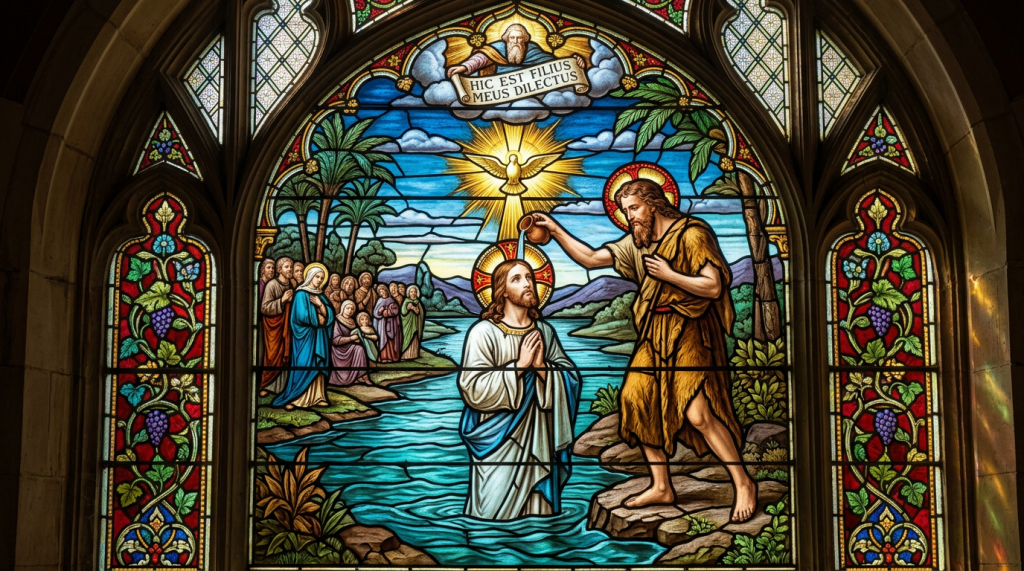
At Jesus’ baptism the three persons appear in a single scene, distinct and undeniable: the Son is baptised, the Spirit descends like a dove, and the Father speaks from heaven, “This is my beloved Son” (Matthew 3:17). You cannot read this as one person quickly changing costumes. Three, together, at once. The early church loved this passage for exactly that reason.
The one name: Matthew 28:19; 2 Corinthians 13:14
Jesus commands his followers to baptise “in the name [singular] of the Father and of the Son and of the Holy Spirit” (Matthew 28:19). Not names, plural; one name, one essence (I AM) shared by three persons. And Paul’s familiar blessing gathers the three as the single source of grace, love, and fellowship: “The grace of the Lord Jesus Christ and the love of God and the fellowship of the Holy Spirit be with you all” (2 Corinthians 13:14). The first Christians were already speaking in threes about the one God, naturally, without embarrassment and without a footnote, as though it were simply the air they breathed.
Now, this part is a bit of a word salad: In Jesus’ culture, a person’s name and the actual person were basically synonymous. When we pray in the ‘name’ of Jesus, it means we pray in the power and authority he has. It’s not a magic formula or phrase. ‘In his name’ means to come as his ambassador, his representative, on his behalf. This is why blaspheming the name of God is taken personally, because how we treat the name is how we treat the one to whom it belongs. If a royal court rejects an ambassador, they therefore reject the one whose name the ambassador represents. When Jesus says to baptise in the name (singular), he is pointing out that God is One in Name. He is One God. One Essence. Jesus identifies 3 persons (Father, Son and Holy Spirit) to whom that One name (One essence) belongs.
The singular ‘name’ here reflects the Jewish understanding that the name carried the full weight of the person’s being and identity. Jesus is not merging three persons into one, nor separating them into three gods; he is identifying three distinct persons who share one divine being.
4. The doctrine unpacked: one in essence, three in persons
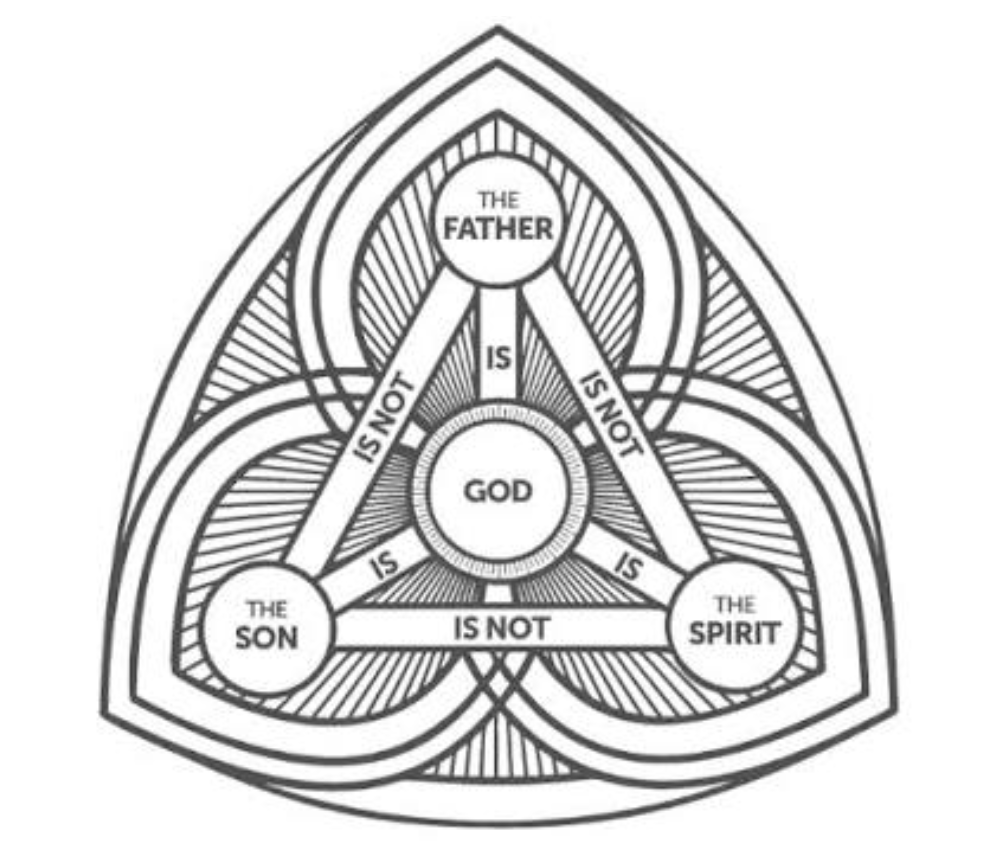
We can now say the truth the way the church has guarded it for almost two thousand years. There is one God who eternally exists as three distinct persons: the Father, the Son, and the Holy Spirit. Or, in the old shorthand, one in essence, three in person. Merge the 3 into one, or break the one into three, and it falls apart; God is One, God is in Three.[^10]
First, the three persons really are distinct. The Father is not the Son, the Son is not the Spirit, the Spirit is not the Father. At the baptism, the Father is in heaven, the Son is in the water, the Spirit is in the air. They are not three masks worn by one actor.
Second, each person is fully God. Not a third each, as if God were a pie cut three ways. “In him [Christ] the whole fullness of deity dwells bodily” (Colossians 2:9); the Spirit is addressed as God (Acts 5:3-4); the Father is obviously God. Each person possesses the entire divine nature.
Third, there is only one God. Distinct, each fully God, and yet one. This is the point where ordinary arithmetic starts to protest. Good; we are describing the Creator of mathematics, the maker of the most intricately fine-tuned universe!
To this the church adds three further guardrails. The persons of the Godhead are:
- co-equal (none higher or lower in nature, power, or glory)
- co-eternal (none came into being; there was never a moment when the Son or the Spirit “started”)
- uncreated (the Father did not make the Son or the Spirit)
That last point is exactly where groups like the Jehovah’s Witnesses and the Latter-day Saints (Mormons) part company with historic Christianity, by treating the Son as a created being. But John 1 told us that there is nothing created, that the Word (who was with God and is God) did not create. And that Word became flesh and dwelt among us. How can the creator create himself? It’s nonsense. The second person of the Trinity, the eternal Son, the Word, was not created. He is co-eternal with the Fathe and the Spirit.
Such groups (JWs, etc) will turn to the verse that says Jesus is the “Firstborn over all creation” (Col 1:15). This is not Paul saying that Jesus was born. He is talking about Jesus being the heir to all creation, as though a firstborn son would have. Secondly, he is the firstborn of the dead unto eternal life. Lazarus was raised, but died again. Jesus was raised, and will never die again. He’s the first to ever do it. The firstborn of the new humanity. Further evidence is in the same verse of Colossians 1:15, that Jesus is ‘the image of the invisible God’, and then verse 16 says he created all things, and verse 17 says he is before all things, and verse 19 that in Jesus the ‘fullness of the deity dwelled bodily’. The broader context of Colossians 1 demands that we accept Jesus as the embodiment of the uncreated and eternal God. Jesus is the firstborn (the heir/rightful owner) of creation, but he was not ‘born’ or created.
Now to the most beautiful part.
Only a triune God can have been loving from all eternity.
Think it through. Love needs someone to love. A god who was utterly alone before he made the world could perhaps become loving once he had creatures to love, but he could not have been love in his own nature from eternity, because there was no one there to love. But if God is, eternally, the Father loving the Son in the Spirit, then love is not something God learned or switched on when the universe appeared. Love is what God has always been doing, inside himself, before there was a single atom. This is why “God is love” (1 John 4:8) is a true sentence and not just a warm one. C. S. Lewis said it well: God “is not a static thing, not even a person, but a dynamic, pulsating activity, a life, almost a kind of dance.”[^11] Tim Keller draws out what that dance is like: “Each of the divine persons centers upon the others. None demands that the others revolve around him… Each person of the Trinity loves, adores, defers to and rejoices in the others.”[^12] At the very centre of reality, in other words, is not self-regard but self-giving love.
And here is the great surprise of the Gospel: this eternal fellowship of love is not a sealed, private club. Through the Son and by the Spirit, we are invited in. John says he writes “so that you too may have fellowship with us; and indeed our fellowship is with the Father and with his Son Jesus Christ” (1 John 1:3). You were made for that; to be in Christ is to be in Love itself. Mind-blowing, right?
Want to get updates when new articles are published?
5. How we got here: the Fathers and the councils
Sometimes people imagine the Trinity was voted into existence by a committee of bishops centuries after Jesus, perhaps with the Emperor leaning on the scales. (The novel The Da Vinci Code made a fortune popularising a version of this.) It is worth knowing the real history, because it is both more interesting and more reassuring.
The worship came first. Long before any council, ordinary Christians were already treating Jesus as God. Around the year AD 112, a Roman governor named Pliny the Younger wrote to the Emperor Trajan reporting that the Christians he interrogated met before dawn and sang hymns “to Christ as to a god.”[^13] That is a hostile outside witness, writing within living memory of the apostles, telling us that Jesus was already being worshipped as divine. A few years earlier still, Ignatius of Antioch, on his way to be martyred, wrote letters that repeatedly call Jesus “our God.” The deity of Christ was not invented in the fourth century; it was sung in the first.
The crisis came from a clever man named Arius. In the early 300s, a popular preacher in Alexandria named Arius began teaching that the Son was the highest and first of God’s creatures, but still a creature, so that “there was a time when he was not.” It was tidy, it was easy to grasp, and it was deadly, because it made Jesus less than God. Standing against him was a young deacon (later bishop) named Athanasius, who saw what was at stake: if Jesus is not fully God, then Jesus cannot save us, because only God can rescue us from sin and death. Athanasius spent his life defending this truth, often utterly outnumbered; later Christians remembered him by the phrase Athanasius contra mundum, “Athanasius against the world.”
The councils did not invent the truth; they fenced it. At the Council of Nicaea (AD 325), the assembled bishops overwhelmingly rejected Arius and confessed that the Son is “of one substance with the Father”, in Greek homoousios. The contrast was a single letter: the Arians could accept that the Son was homoiousios, of a similar substance, but Scripture demanded homoousios, the same substance. One iota of difference, and the gospel hung on it. (Interesting, you may recall that Jesus commented that not one iota would be missing from the Law… Punctuation, spelling and grammar all matter, which is why a reliable translation matters when it comes to reading and studying the Bible). The vote, by the way, was lopsided; only a handful sided with Arius. This was no close-run political stitch-up. The Council of Constantinople (AD 381) completed the work by affirming the full deity of the Holy Spirit, giving us essentially the Nicene Creed many churches still recite.
The Fathers gave us our language. The great teachers of the early church, the Cappadocian Fathers (Basil of Caesarea, Gregory of Nazianzus, and Gregory of Nyssa) in the East, and Augustine of Hippo in the West, worked out careful ways to speak: one ousia (essence) in three hypostases (persons). Gregory of Nazianzus left us one of the loveliest descriptions ever written of what it feels like to worship this God: “No sooner do I conceive of the One than I am illumined by the splendour of the Three; no sooner do I distinguish them than I am carried back to the One.”[^14] Augustine, in his massive work On the Trinity, offered a meditation that has fed the church ever since: where there is love, there is a lover, a beloved, and the love that flows between them; perhaps, he suggested, we glimpse something of the Father, the Son, and the Spirit who is the love between them.[^15]
So when you confess the Trinity, you are not repeating a fourth-century invention. You are standing in a river of worship that runs back through the councils, past the Fathers, to the apostles, and to the lips of Jesus himself.
6. Common objections and misconceptions
Because this doctrine sits at the centre, it gets attacked and muddled in every generation. Knowing the common errors is not theological trivia; it is how you guard your own heart and help a friend. The Athanasian Creed, written precisely to fence this truth, gives us the rule of thumb: worship one God in trinity, “neither confounding the persons nor dividing the substance.”[^16] Almost every error falls off one side of that line or the other. It either smudges the three persons together or splits the one God apart.
“It’s just bad maths. One plus one plus one equals three, not one.” This only works if we are saying God is three of the same thing and also one of the same thing, which would indeed be nonsense. But that is not the claim. God is three in one respect (persons) and one in a different respect (essence). There is no contradiction in something being one what and three whos. As R. C. Sproul patiently insisted, the Trinity is a mystery, not a contradiction; it is above our reason, not against it.[^17]
Modalism (the “three masks” error). This is the idea that God is really one person who simply shows up in three modes, Father in the Old Testament, Son in the Gospels, Spirit today, like one actor in three costumes. It feels simple, which is why it keeps coming back. It is also the error behind the popular “water, ice, and steam” picture: the same H₂O in three forms, but usually only one form at a time. And that is precisely the problem. At the baptism, the Father, Son, and Spirit are all present at once; they are not three phases of one person. This matters for our own tribe to hear clearly: some Pentecostal groups (often called “Oneness” or “Jesus Only” or “Apostolic”) have revived modalism, baptising only “in the name of Jesus” and denying that Father, Son, and Spirit are distinct persons. They love Jesus, but on this point they have stepped outside the historic Christian faith, and we should lovingly say so.
Arianism (the “Jesus is a created being” error). Revived today most visibly by the Jehovah’s Witnesses, this says the Son is the first and greatest creature, but not eternal God. As discussed above, their go-to verse is Colossians 1:15, “the firstborn of all creation.” But “firstborn” in the Bible regularly means the heir, the one with supreme rank, not the first one made; and the very next verses say all things were created “by him… and for him” (Colossians 1:16). The maker of all things cannot be one of the things made.
Partialism (the error hiding in almost every analogy). The three-leaf clover (three leaves, one shamrock) and the egg (shell, white, yolk) both quietly turn the persons into thirds of God. But the Father is not 33 per cent of God. Each person is fully and wholly God.
Here is the pastoral takeaway: every analogy for the Trinity eventually breaks down, and if you push it, it will teach a heresy. That is not a weakness in the doctrine. It is exactly what we should expect when finite creatures try to draw a picture of the infinite Creator who does not fit inside creation’s categories (Isaiah 55:8-9). We are the clay trying to describe the potter. The right response is not to keep hunting for a cleverer analogy but to bow in worship.
“But Jesus said ‘the Father is greater than I’ (John 14:28). Doesn’t that make him lesser?” A fair question, and an important one. The historic answer distinguishes between who God is (his nature) and the roles the persons take in our salvation. In his very nature, the Son is fully equal to the Father. But in becoming human and going to the cross, the Son willingly took the lower place, “did not count equality with God a thing to be grasped, but emptied himself” (Philippians 2:6-7). A son can be fully, equally human with his father and still honour and obey him. “Greater” here is about role and position in the work of redemption, not about being a lesser kind of God.
7. Answering the Muslim objection
Some of us may have Muslim friends, neighbours, and workmates, and the Trinity is the single biggest thing Islam objects to in Christianity. It is worth understanding the objection fairly, and then seeing how the gospel answers it, because the answer is not defensive; it is good news (for more, check out God Logic on YouTube, or David Wood on YouTube, both great apologists regarding Islam and the Gospel)
What Islam teaches. At the heart of Islam is tawhid, the absolute, undivided oneness of God. The gravest sin in Islam is shirk, associating any partner with God. From that starting point, the Trinity looks like the worst possible error. The Qur’an directly warns Christians, “do not say ‘Three’… God is only one God” (Surah 4:171), and “He neither begets nor is begotten” (Surah 112:3). A Muslim hears “Son of God” and pictures God physically fathering a child, which is rightly offensive to them, and to us. So the objection usually comes in two parts: you Christians are really polytheists worshipping three gods, and it is blasphemous to say God has a son.
Answering the first objection: we are not polytheists. This is the most important thing to say plainly and early. Christians worship one God, not three. We stand on the Shema: “The LORD our God, the LORD is one” (Deuteronomy 6:4). We do not believe in three gods who team up. We believe in one God who eternally exists as three persons, one essence, three persons, which is a very different claim. (It is worth knowing that the Qur’an itself seems to picture the Christian Trinity as God, Jesus, and Mary (Surah 5:116), which no Christian has ever believed. The Trinity Islam rejects is not actually the Trinity the church confesses.) So a great deal of the disagreement clears the moment we explain what we are not saying.
Answering the second objection: “begotten” does not mean “made”. When the church confesses the Son as “begotten, not made,” it is saying the opposite of what a Muslim fears. “Begotten” here has nothing to do with biology or a beginning. It is a way of speaking about an eternal relationship: the Son comes from the Father the way light comes from a flame or a word comes from a mind, always, with no point at which the flame was without its light. The Son was not created at a moment in time. He is eternally the Son of the eternal Father. So we are not saying God had a wife and a baby. We are saying that within the one God there has always been a relationship of Father and Son.
Secondly, for God the Father to be unchanging (immutable), it means he must have always been a Father. To be the eternal Father, there must be an eternal Son. To deny that the Son is eternal, and to therefore say the Son was at some point created, is also to say that at some point in time, God became a Father, and before that, he was not a Father; in other words, God changed a fundamental aspect of his nature. If God can change, then he cannot be trusted to remain the same, yet the Lord declares he is the same yesterday, today, and forever (See Malachi 3:6 and Hebrews 13:8).
The good news inside the disagreement. Here is where the conversation can turn from debate to invitation. Press gently on tawhid with the question we raised earlier: if God is a single, solitary person, then before he made the world, whom did he love? On the Islamic view, God could not have been loving in his eternal nature, because there was no one there for him to love; love only begins once creation gives him an object. But the Christian God is love in his very being (1 John 4:8), because the Father has loved the Son in the Spirit from all eternity. The Trinity is not an awkward complication that makes God harder to believe in. It is the only thing that makes “God is love” true. A solitary god can be powerful, can be merciful, can be just. Only a triune God can have been love itself, forever. That is not a smaller God than Islam offers. It is an infinitely warmer one, and your Muslim friend was made for him too.
8. Short list of scriptures that highlight the deity of each Person of the Trinity
This is just a brief list of scriptures (there are a lot more) that show the divine nature of each Person of the Trinity.
The Father is God
- Genesis 1:1 – God the Father creates the heavens and earth
- Malachi 2:10 – “Have we not all one Father” who created us
- John 17:3 – Jesus calls the Father “the only true God”
- 1 Corinthians 8:6 – “one God, the Father, from whom are all things”
- Ephesians 4:6 – “one God and Father of all”, over all
- 1 Peter 1:2 – believers chosen “according to the foreknowledge of God the Father”
The Son is God
- Isaiah 9:6 – the coming child named “Mighty God, Everlasting Father”
- John 1:1, 14 – the Word was God, and became flesh
- John 8:58 – Jesus takes God’s own name, “before Abraham was, I am”
- John 10:30 – Jesus states plainly, “I and the Father are one”
- John 20:28 – Thomas worships the risen Jesus as “my God” and Jesus accepts it
- Colossians 1:15-20 — He is the image of the invisible God, Creator of all, the fullness of God in bodily form
- Colossians 2:9 – “the whole fullness of deity dwells” in Christ bodily
- Titus 2:13 – believers await “our great God and Savior, Jesus Christ”
- Hebrews 1:8 – the Father addresses the Son directly as “God”
- Revelation 1:8, 17 – Christ claims the divine titles “Alpha and Omega”, “the first and the last”
The Holy Spirit is God
- Genesis 1:2 – the Spirit of God hovers over creation’s waters
- Acts 5:3-4 – lying to the Spirit is called lying to God
- 1 Corinthians 2:10-11 – the Spirit alone knows the depths of God
- 1 Corinthians 3:16 – God’s Spirit dwelling makes believers God’s temple
- 2 Corinthians 3:17-18 – Paul identifies the Spirit as “the Lord”
- Hebrews 9:14 – the Spirit is called “eternal”, a divine attribute
- Psalm 139:7-10 – the Spirit’s presence fills heaven and earth alike
9. Why this matters for your everyday life
It would be a shame to treat all this as a doctrine for the head and not the heart, because it touches everything.
It changes how you pray. Keller notes that even our praying is shaped by the Trinity: we come to the Father, through the Son, in the Spirit.[^18] You are not shouting into the dark. You are being welcomed into a conversation of love that has been going on forever. When we approach ‘the throne of grace,’ we are coming to a God who loves and who is Love. We might tremble before his majesty, but not in fear of being rejected or cast out.
It will lovingly confront some of us. There are some who, due to their own struggles or trauma, want to compartmentalise the Father and just have Jesus and the Spirit. This is usually the result of having a bad experience with a father or father figure, and viewing the God of the Old Testament as the mean, angry, judgmental one, whereas Jesus is the gentle, loving one. Not only is this a gross misunderstanding of scripture, but it also frames God as unjust and unholy in the way he judges sin and sinners throughout the Old Testament, and overlooks that judgement and anger of Christ in the New (calling Pharisees whitewashed tombs isn’t very “nice” and driving people out of the temple with a whip isn’t very “friendly”, is it?). Such people have been lured into the lie of believing Jesus came to save us, whereas the Father just wants to punish us. These people love Jesus, but despise the Father. This theological inconsistency is built on a belief that couldn’t be further from the truth. Remember it was the Father’s will that Jesus would go to the cross (read the prayer of Jesus in Gethsemene), and it was the appearing of the Father’s kindness that led to Jesus coming in the first place (Titus 2), not to mention the types and shadows of Christ throughout the Old Testament that point to the cross being God’s plan all along. In his single-chapter epistle, Jude makes it even more clear how inseparable the Father and Son are by saying it was “Jesus, who saved a people out of the land of Egypt, [and who] afterward destroyed those who did not believe” (Jude 1:5). Jesus is the same God of the Exodus. You cannot accept Jesus as Lord without accepting Jesus as the God of the Bible, and that includes the Old Testament. If this is a struggle for you, or someone in your small group, humble repentance is the way out. Ask for healing in the areas where you have been hurt, and then ask for forgiveness for unjustly projecting that pain onto the Father.
It anchors your worth. You were made by a God who was never lonely, never needy, never created you to fill a hole in himself. He made you out of the overflow of a love that was already complete. You exist because joy spilled over, not because God was incomplete without you. That is a far steadier ground for your worth than your performance, and your worth is rooted in the immutability of your creator, and not in your achievements or personal holiness.
It tells you what reality is really like. If self-giving love is at the very centre of God, then self-giving love is at the very centre of the universe, and a self-centred life is a life lived against the grain of all that is. John Piper, following the old theologian Jonathan Edwards, even dared to describe the Spirit as the very delight and love flowing between the Father and the Son, so full that it stands forth as a third person.[^19] We should hold such ideas humbly, but the direction is right: at the heart of everything is joy.
The Trinity, then, is not finally a riddle to be solved. It is a God to be known, the divine fellowship to be welcomed into.
Scroll to the very bottom if you would like to leave a comment.
10. A five-day reading plan
Fifteen minutes a day. Read the passage slowly, sit with the thought, answer the question honestly (a journal helps).
Day 1. The one God. Read Deuteronomy 6:4-9 and Mark 12:28-34. Thought: The same God Israel confessed as “one”, Jesus confessed as “one”, and then accepted worship that belongs to God alone. Monotheism is not threatened by the Trinity; it is fulfilled by it. Question: What good things in your life have quietly become “gods”, competing for the love the Shema says belongs to God alone?
Day 2. Three present in creation. Read Genesis 1:1-2:3. Thought: God, his Word, and his Spirit are all at work before a single human exists. Creation is the overflow of a God who was never lonely. Question: If the universe flows from a God who is eternally relational, what does that say about why you were made?
Day 3. The Word with God, and as God. Read John 1:1-18. Thought: The Word was with God and was God, and that Word became flesh. The gap between Creator and creature was crossed from God’s side. Question: Verse 14 says the Word “dwelt among us”. Where do you most need the God who is with you and not only above you?
Day 4. The triune name. Read Matthew 3:13-17 and Matthew 28:16-20. Thought: At the start of Jesus’ ministry and at its commission, all three persons are named together, distinct and united. Question: You were (or will be) baptised into the one name of Father, Son, and Spirit. What does it mean to belong to this God by name?
Day 5. God is love. Read 1 John 4:7-21. Thought: “God is love” only makes sense because God is triune; love has flowed between the persons from eternity, and now flows out to us. Question: John ties knowing this God to loving people. Who is hardest for you to love, and how does being loved first by this God change that?
11. Small group discussion questions
- Before this week, how would you have answered a friend who asked, “So do Christians believe in one God or three?” Has anything shifted for you?
- Read Matthew 3:16-17 together. What do you actually see happening in the scene, and why does it rule out the idea that Father, Son, and Spirit are just three “modes” of one person?
- Why do you think the Creed (and this series) starts with God rather than with us? What goes wrong when we start with ourselves instead?
- Walk through the failed analogies (water/ice/steam, the egg, the clover). Which had you used or heard before? What error does each one accidentally teach?
- The guide argues that only a triune God can have been loving from all eternity. Talk it through. Does it land for you? How might you use it in a conversation with a Muslim or atheist friend?
- “The Trinity is a mystery, not a contradiction.” How is that distinction freeing rather than frustrating?
- It can be unsettling to learn that some sincere believers (for example, Oneness Pentecostals or Jehovah’s Witnesses) get this wrong. How do we hold firmly to the truth while still loving people who disagree?
- Application: Name one specific way that knowing God as Trinity could change how you pray, or how you see your own worth, this week.
11. Going further
A short list for those who want to keep digging. Free and online where possible; the rest are well worth owning.
- R. C. Sproul, What Is the Trinity? The best brief, careful starting point. Read the free article as part of The Mystery of the Trinity at Ligonier.
- Desiring God (John Piper and others), “What Is the Doctrine of the Trinity?” and “Are You Thrilled by the Trinity?”
- Tim Keller, The Reason for God, chapter 14, “The Dance of God”.
- C. S. Lewis, Mere Christianity, Book IV (“Beyond Personality”). The classic popular treatment of God as a “dance” of love.
- Michael Reeves, Delighting in the Trinity. Short, warm, and genuinely joyful; the best next step after this guide.
- The ecumenical creeds. Read the Apostles’, Nicene, and Athanasian Creeds for yourself; the Athanasian Creed is the church’s most precise guardrail around this doctrine.
Select bibliography
Augustine of Hippo. On the Trinity. Trans. Arthur West Haddan. Nicene and Post-Nicene Fathers, 1st series, vol. 3.
Danker, Frederick William, ed. A Greek-English Lexicon of the New Testament and Other Early Christian Literature (BDAG). 3rd edn. Chicago: University of Chicago Press, 2000.
Keller, Timothy. Prayer: Experiencing Awe and Intimacy with God. New York: Dutton, 2014.
Keller, Timothy. The Reason for God: Belief in an Age of Skepticism. New York: Dutton, 2008.
Lewis, C. S. Mere Christianity. London: Geoffrey Bles, 1952; repr. New York: HarperOne, 2001.
Piper, John. ‘Can We Explain the Trinity?’ Desiring God. https://www.desiringgod.org/articles/can-we-explain-the-trinity.
Pliny the Younger. Letters 10.96. https://faculty.georgetown.edu/jod/texts/pliny.html.
Reeves, Michael. Delighting in the Trinity: An Introduction to the Christian Faith. Downers Grove, IL: IVP Academic, 2012.
Sproul, R. C. What Is the Trinity? Crucial Questions 10. Sanford, FL: Reformation Trust, 2011.
Tozer, A. W. The Knowledge of the Holy. New York: Harper & Row, 1961.
Warfield, B. B. ‘The Biblical Doctrine of the Trinity’. In Biblical Doctrines. New York: Oxford University Press, 1929.
The Athanasian Creed. Christian Reformed Church in North America. https://www.crcna.org/welcome/beliefs/creeds/athanasian-creed.
Footnotes
[^1]: Scripture quotations are from The Holy Bible, English Standard Version (Wheaton, IL: Crossway, 2016) unless marked NLT, Holy Bible, New Living Translation (Carol Stream, IL: Tyndale House, 2015). Passage links go to Bible Gateway.
[^2]: Michael Reeves, Delighting in the Trinity: An Introduction to the Christian Faith (Downers Grove, IL: IVP Academic, 2012), 18, quoted in Greg Morse, ‘Are You Thrilled by the Trinity?’, Desiring God, desiringgod.org (accessed 31 May 2026).
[^3]: A. W. Tozer, The Knowledge of the Holy (New York: Harper & Row, 1961), 1.
[^4]: B. B. Warfield, ‘The Biblical Doctrine of the Trinity’, in Biblical Doctrines (New York: Oxford University Press, 1929); the “richly furnished but dimly lit room” image is Warfield’s well-known summary of the Old Testament’s witness to the Trinity.
[^5]: Tertullian used the Latin trinitas in Adversus Praxean (Against Praxeas), c. AD 213, while defending the distinction of the three persons against modalism.
[^6]: On the disputed etymology of perichoresis, see Kevin J. Bidwell’s discussion in Engaging with Keller: Thinking Through the Theology of an Influential Evangelical, ed. Iain D. Campbell and William M. Schweitzer (Darlington: EP Books, 2013). The term’s settled meaning is the mutual indwelling (co-inherence) of the three persons, as used by John of Damascus, not “dance”.
[^7]: Read the full passage at Bible Gateway (ESV) and (NLT).
[^8]: The “compound unity” argument from echad is common in popular apologetics but is not sustainable on lexical grounds. Echad is the ordinary cardinal number “one” and takes its sense from context; the doctrine of the Trinity does not rest on it.
[^9]: Frederick William Danker (ed.), A Greek-English Lexicon of the New Testament and Other Early Christian Literature (BDAG), 3rd edn (Chicago: University of Chicago Press, 2000), s.v. “πρός”, which includes among its senses association or relationship (“in company with, with”) taken with the accusative.
[^10]: The three-part definition follows Matt Perman, ‘What Is the Doctrine of the Trinity?’, Desiring God, desiringgod.org (accessed 31 May 2026).
[^11]: C. S. Lewis, Mere Christianity (London: Geoffrey Bles, 1952; repr. New York: HarperOne, 2001), Book IV, ch. 4 (‘Good Infection’).
[^12]: Timothy Keller, The Reason for God: Belief in an Age of Skepticism (New York: Dutton, 2008), ch. 14, ‘The Dance of God’, 214-215.
[^13]: Pliny the Younger, Letters 10.96, to the Emperor Trajan, c. AD 112. A widely used translation is available at Georgetown University (accessed 31 May 2026).
[^14]: Gregory of Nazianzus, Oration 40.41 (‘On Holy Baptism’); translation from the Nicene and Post-Nicene Fathers, 2nd series, vol. 7.
[^15]: Augustine of Hippo, On the Trinity (De Trinitate), Books 8-9; the analogy of lover, beloved, and the love between them.
[^16]: The Athanasian Creed, English translation approved by Synod 1988, Christian Reformed Church in North America, crcna.org; see also the Reformed Church in America translation at rca.org.
[^17]: R. C. Sproul, What Is the Trinity?, Crucial Questions 10 (Sanford, FL: Reformation Trust, 2011); the free version is at ligonier.org (accessed 31 May 2026).
[^18]: Timothy Keller, Prayer: Experiencing Awe and Intimacy with God (New York: Dutton, 2014), 66.
[^19]: John Piper, ‘Can We Explain the Trinity?’, Desiring God, desiringgod.org (accessed 31 May 2026), summarising Jonathan Edwards.
Discover more from Seeds & Streams
Subscribe to get the latest posts sent to your email.
