
Maybe you’ve heard it said, or prayed, and maybe you’ve even said it yourself that the anointing breaks the yoke, but have you ever filtered this common pentecostal catchphrase through what the Bible actually says? Does the Bible actually teach us that the yoke is broken by the anointing? Based on what scripture? Let’s dive in…
As Christians, our entire belief system is based on the premise that the Lord has broken through on our behalf, that while we were dead in our sins and enemies of God, Christ died for us to break us free from the shackles of sin and death[mfn]Ephesians 2:1-10[/mfn]. God moved when we could not. God intervened where we could not. God won a victory that we could not. God redeemed us and set us free for we could not do it ourselves; we needed Him to breakthrough on our behalf.
This Gospel-based definition of God breaking through for us is not debatable in the world of Christian theology; it’s the foundation stone – Jesus died for us, to set us free from sin and death. But can this notion of God doing all the heavy lifting to rescue be applied in a copy-and-paste approach to all other facets of Christian life and doctrine? Is it right to say that the anointing breaks the yoke? First, let’s consider the scripture being referenced when people use this commonly heard phrase.
…and the yoke will be destroyed because of the anointing
Isaiah 10:27 – KJV
translation comparison
Those who grew up in the church a few decades ago know the scriptures best in the King James Version as it was the most widely acceptable and available English translation. However, over the years many new translations have been produced and continuously get updated as translators learn more about the ancient languages and the subtle nuances of words these ancient worlds and phrases from an era long past (I did a whole post on Bible Translations here). For those who are cautious of new translations and only use the KJV, they often overlook the fact that the KJV has been revised several times[mfn]As pointed out here by Thomas Nelson Publishing[/mfn], meaning it too continues to be sharpened and honed by the translators as is expected.
So how do other translations approach Isaiah 10:27? Here’s a broad range:
- AMP – The yoke will be broken because of the fat.
- CSB – The yoke will be broken because your neck will be too large.
- DARBY – and the yoke shall be destroyed because of the anointing
- ESV – and the yoke will be broken because of the fat
- NASB – the yoke will be broken because of fatness.
- NIV – the yoke will be broken because you have grown so fat
- NLV – and it will be broken because you are so fat
- NKJV – And the yoke will be destroyed because of the anointing oil
- HCSB – The yoke will be broken because of fatness
- LEB – and a yoke will be destroyed because of fat
- See about 50 more translations here
As you can see, there is a bit of variation in how the translators have approached this verse especially in regards to the word that is translated as fat, fatness, oil, or anointing. And yes, this really does matter!
how you interpret this verse will have a huge impact on how you pray, how you respond to trials and challenges, how you engage with the lords discipline, and how you cooperate with the holy spirit
broken by the anointing or the fat?
To understand how these two interpretations came about we need to look at the original language and the original context, and then consider why most modern translations opt for the ‘fatness’ and not the ‘anointing’ – and why that matters so much to the life of a believer!
1. Context
In the same way most people who quote the very tweetable Jeremiah 29:11 completely out of context (I may do a post on that one day too), this scripture about the yoke being broken is often removed from its context, divorcing it from its original meaning and butchering its application. When we do this, we are shaping and moulding the text to suit our preconceived ideas (our bias) rather than allowing the text to shape and mould us.
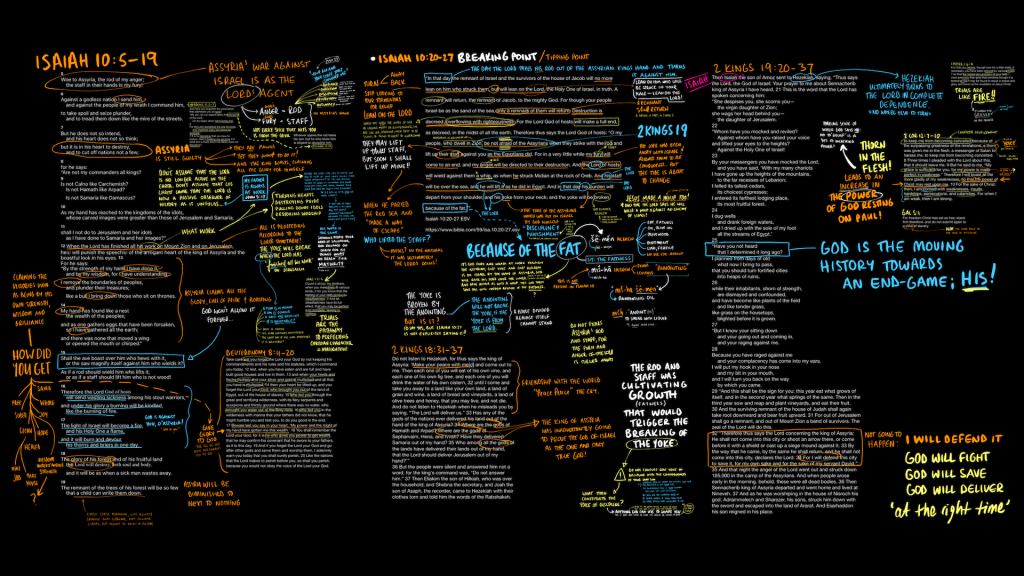
In Isaiah chapter 10, the prophet is describing the war that Assyria has waged against Israel, and that this is the work of God as punishment/discipline towards Israel’s idolatry and rebellion, check out verses 5-6:
Woe to Assyria, the rod of my anger;
the staff in their hands is my fury!
Against a godless nation I send him,
and against the people of my wrath I command him,
to take spoil and seize plunder,
and to tread them down like the mire of the streets (ESV)
God describes, through the prophet, that Assyria is acting as an agent of God’s wrath and fury and that he was the one who sent them against Israel for being a ‘godless nation’. What follows this is God’s judgement on Assyria’s King for attributing his military success to his own brilliance and strength instead of the Lord; verse 12-13 is crucial here:
When the Lord has finished all his work on Mount Zion and on Jerusalem, he will punish the speech of the arrogant heart of the king of Assyria and the boastful look in his eyes. For he says: “By the strength of my hand I have done it,
and by my wisdom, for I have understanding;
I remove the boundaries of peoples,
and plunder their treasures;
like a bull I bring down those who sit on thrones (ESV)
The king of Assyria is proud and boastful, taking all the credit for what God has been doing. But notice it says that the Lord will punish the king, but not until he has finished all his work on Mount Zion and Jerusalem. God is at work here, he is using Assyria to achieve something, to achieve some kind of work that is directed at Mt Zion and Jerusalem; work that is is about to be finished. This is key.
The prophet then begins to declare that the day of this work being finished is approaching with the repeated phrase ‘in that day’[mfn] Isaiah 10:20 and Isaiah 10:27[/mfn]. Two very important things will happen ‘in that day’, firstly, God will break out against Assyria and in doing so will bring relief to the remnant of Israel. Secondly, the yoke on Israel’s neck (which we will define in a moment) will be broken off. Verses 24-27 bring us to the crescendo;
24Therefore thus says the Lord God of hosts: “O my people, who dwell in Zion, be not afraid of the Assyrians when they strike with the rod and lift up their staff against you as the Egyptians did. 25 For in a very little while my fury will come to an end, and my anger will be directed to their destruction. 26 And the Lord of hosts will wield against them a whip, as when he struck Midian at the rock of Oreb. And his staff will be over the sea, and he will lift it as he did in Egypt. 27 And in that day his burden will depart from your shoulder, and his yoke from your neck; and the yoke will be broken because of the fat.” (ESV)
See, when you read through the entire passage of scripture (and the parallel passages in 2 Kings 18:31-37 and 2 Kings 19:20-37) it is plain to see that the yoke being broken off Israel’s neck is not a yoke of slavery or of demonic oppression, it is not a yoke the devil has put on them, but it was a yoke of punishment and discipline that the Lord put on them himself through the hands of the Assyrians.
the yoke being broken was put on them by the lord, not by the devil. So to ask god to break the yoke (in this case) would be to ask god to go to war against himself
Remember verse 5; the “rod and staff” in the hands of the Assyrians was the rod of God’s anger and the staff of his fury! His items are in their hands. Now have another look at verses 24-27 above, do you notice who owns the burden and who owns the yoke? The same one who owns the rod and the staff. The burden that was upon Israel, the yoke on their necks was the Lords! His yoke, Assyria’s hands. It was the yoke of discipline, the yoke of punishment and correction, the yoke of a good father steering his wayward son back on course. The ‘work’ that the Lord was about to complete was the work of discipline – getting Israel to grow up and become faithful – and it was about to be finished with the climactic breaking of the yoke.
2. IS שֶׁמֶן (šě·měn) ANOINTING OIL OR FAT?
The original word in Isaiah 10:27 that is in focus is the Hebrew word שֶׁמֶן (šě·měn) which can be translated as oil (from olives) or fat, or fatness. It could also be used to describe ointments, olive-wood, fertility and land that is lush and rich is said to šě·měn[mfn]As defined in the Gesenius’ Hebrew-Chaldee Lexicon to the Old Testament, and the Dictionary of Biblical Languages with Semantic Domains: Hebrew (Old Testament)[/mfn]. The lack of it is how the Psalmist described himself as being gaunt due to fasting – having no fat/šě·měn[mfn]Psalm 109:24[mfn]. This explains why the translators are able to use oil and fat, technically neither is incorrect, but theologically and contextually one of them is more accurate.
To describe šě·měn as anointing oil requires an extra Hebrew word to be present in the text. ‘Anointing oil’ appears in Exodus 25:6 and about 20 times throughout Exodus and Leviticus when the Lord is giving Moses the instructions/recipe for making and using it to anoint the priests and the tabernacle. It’s the combination of מִשְׁחָה (miš·ḥā(h)) and שֶׁמֶן (šě·měn). It is the first part, miš·ḥā(h), that gives us our English word ‘anoint’ or ‘anointing’; it means to smear or pour a liquid (or semi liquid) on a person as a religious activity or to dedicate a person or thing for service[mfn]Dictionary of Biblical Languages with Semantic Domains: Hebrew (Old Testament)[/mfn]. Without the use of miš·ḥā(h), the type of šě·měn that Isaiah is referring to in 10:27 cannot possibly be a reference to anointing oil, and therefore it cannot be referring to “the anointing”.
2.A SIDE NOTE: WHAT IS “THE ANOINTING”?
Important: Although it’s a side note, let me quickly touch on this, because ‘the anointing’ is what some people are saying is the thing that breaks the yoke.
When Jesus declared that the Spirit of God was upon him in Luke 4:18, he quoted Isaiah 61:1 saying that The Spirit of the Lord God is upon me, because the Lord has anointed me… miš·ḥā(h). Jesus was saying that in the same way the oil was poured on the priests to anoint them for service, He had received the Holy Spirit upon him, anointing him for service.
Jesus then told the apostles that they too would receive the Holy Spirit (Acts 1:8) to equip them for service as his witnesses. Then is Acts 2:17, when Pentecost had happened, Peter stood up and explained the phenomenon as being the fulfilment of the prophet’s Joel’s words, And in the last days it shall be, God declares,
that I will pour out my Spirit on all flesh. The word ‘pour’ invokes the imagery of liquid flowing from a jug, which is exactly what anointing a person looks like.
In short, when a person talks about ‘the anointing’, they are… we are, talking about the power of the Holy Spirit, the supernatural empowerment and activity of God. The opposite (or antithesis) to the anointing is human effort without grace. When we say that something happens as a result of ‘the anointing’, we are giving God all the credit and making it plain that we were not the agents of change in and of ourselves; God has intervened. On the other hand, without the anointing, all you get is the person’s best efforts. A person can’t heal you, but the anointing flowing through her while she prays can. A preacher can’t set you free, but the anointing, while he preaches, can. The musicians can’t cause people to encounter the Spirit of God, but the anointing upon them while they use their gifts can. Thank God for the anointing!
3. FAT NECKS
When interpreting שֶׁמֶן (šě·měn) in their 2003 dictionary of Hebrew and Chaldee, W. Gesenius & S.P Tregelles, write that “the yoke (of Israel) is broken because of fatness,” a metaphor taken from a fat bull that casts off and breaks the yoke [mfn]Gesenius, W., & Tregelles, S. P. (2003). Gesenius’ Hebrew and Chaldee lexicon to the Old Testament Scriptures (p. 835)[/mfn] The description Isaiah gives of how the yoke will break is that Israel, like a fat bull, will outgrow it. By becoming bigger, or fatter, the yoke will not be able to remain in place.
The work that God was doing was the work of discipline and correction. His goal was never to break Israel and simply beat them down into some kind of new slavery; his goal was to use Assyria as a stimulant for growth. As Israel responded, through repentance and by returning to true worship (albeit slowly and unimpressively under King Hezekiah), they eventually became ‘fat’ enough and God’s work of drawing Israel back to dependence upon him alone was complete. He put a yoke on them with the intention that they would outgrow it.
get fat
Too often, waiting for ‘the anointing’ is the excuse we can hide behind when we ‘need breakthrough’ and we haven’t got it yet. But what if instead of waiting for the Lord to do all the heavy lifting we are actually meant to grow and become fat? What if we are supposed to participate with the Holy Spirit’s work in our lives and mature and grow as believers, outgrowing our challenges instead of getting ‘breakthrough’? What if God wants to use your circumstances to grow us, and not just deliver us from every challenge and hardship?
In this you rejoice, though now for a little while, if necessary, you have been grieved by various trials, so that the tested genuineness of your faith—more precious than gold that perishes though it is tested by fire—may be found to result in praise and glory and honor at the revelation of Jesus Christ. 1 Peter 1:6-7
We all love breakthrough and instant healing, miracles, provision and the like. We love the way these moments reveal parts of the divine personality of God, that just as he is The Lord our Provider, Healer, and Redeemer, he is also revealed as Baal Perazim[mfn]2 Samuel 5:20[/mfn], The Lord who Breaks Out against our enemies; which He certainly did on the cross! He has delivered us from the domain of darkness[mfn]Colossians 1:13-14[/mfn], he has broken our bonds of guilt and shame, breaking the yoke of slavery to sin and bringing us out of death and into life! Hallelujah! But there’s a flip-side… we must grow and mature[mfn]1 Corinthians 14:20, Ephesians 4:13, Colossians 1:28, Colossians 4:12, 1 Peter 2:2[/mfn]. We cannot sit on our hands expecting ‘the anointing’ to do all the work. We must learn as Paul did, how to put the anointing to work. We must work hard at our faith and in using all God has given us in order that we might grow, be transformed and mature.
But by the grace of God I am what I am, and his grace toward me was not in vain. On the contrary, I worked harder than any of them, though it was not I, but the grace of God that is with me.
1 corinthians 15:10
Paul puts it’s perfectly. There is such a blurred line between the effort we put in and the amount of productivity that is the result of grace. The grace of God and the anointing of the Holy Spirit are wonderful things, but they are meant to empower and equip us so that we are effective and fruitful in our labor – not just in ministry, but the labor of growth. Don’t let a distorted interpretation of Paul’s letter to the Galatians about human effort rob you from this truth, that while salvation is a free gift, the life of faith and maturity involves hard work in partnership with the grace and anointing of the Holy Spirit. “Human Effort” has been turned into dirty words in many hyper-faith circles where Galatians is misunderstood and divorced from the rest of scripture (I’m working on producing a commentary on Galatians for this very reason).
I’m all for breakthrough and I’m all for the power of God touching lives, healing bodies, hearts and minds in sudden and supernatural ways! I love it! I pray for it and I’ve experienced it! Yet I’m also for seeing people grow – and sometimes that means that the yoke of discipline will be upon their necks until they do; until I do.
So does ‘the anointing break the yoke?’ Not based on Isaiah 10:27. And no, such a phrase does not exist anywhere else in scripture. Ezekiel and Jeremiah talk a lot about God breaking the yokes of other nations, the Psalmists talk about the yoke of the Egyptians being broken through the Exodus, but they make no reference to ‘the anointing’ being involved.
Does God supernaturally intervene in our lives? Yes! Why follow Christ if he doesn’t!? God does rescue, he does heal, he does deliver, he does set us free, he does bind up broken hearts and still restless souls, and you could say that it is ‘the anointing’ doing these things, and you could say that the things he rescues us from are like “yokes” being broken. Is it just a matter of semantics and language? I don’t think it is. The problem is when we say ‘the anointing breaks the yoke’ we are invoking a wrong interpretation of scripture and therefore failing to understand the truer and wider implications of Isaiah 10:27. We fail to see God using yokes. We fail to understand that we are meant to yield to his yoke, not ask for breakthrough from it. Perhaps the reason that ‘yoke’ hasn’t broken yet is that you’re waiting for the anointing to do it while the Anointed one is waiting for you seek him on how you ought to outgrow it. Sometimes praying and asking for wisdom and discernment is greater than asking for a breakthrough.
Not every “yoke” is meant to be broken by God’s intervention, by the spontaneous power of the anointing, sometimes the yoke is meant to be outgrown.
final side note: the devil and his “yokes”
So while Isaiah 10:27 is not talking about the anointing as such, we can’t ignore the fact that there are times in our lives where the ‘yoke’ we feel, the oppression, challenges, pain, suffering, etc… are not yokes of discipline from the Lord but are direct attacks from the enemy camp (I did a post here about spiritual warfare).
There are times when God allows or permits the devil to launch his assault against us instead of stopping it. When the devil wanted to sift Peter, Jesus simply told Peter that he had prayed for his faith not to fail (Luke 22:31-34). Paul talked about a messenger from satan that tormented him as being a thorn in his flesh, which after praying numerous times God didn’t take it away (2 Corinthians 12:7-10). There are times when the devil is attacking us, but God allows it as he sees a way of achieving greater purposes through the process of endurance. So was Assyria carrying God’s staff and rod? Or were they doing the devils work? Isaiah told us clearly that in that specific case it was God’s rod and staff in the hands of the Assyrians. This is why you can’t copy and paste scripture and call it doctrine – you need to consider the context, which is what we’ve tried to do here.
It’s not always easy however, to know in the moment whether the trial we’re facing is from the Lord’s discipline or the devils agenda, but we can be sure that if we speak to the Lord and ask for wisdom on the matter that he will give it to us (just don’t be a Job’s comforter to those around you that you see suffering).
There’s a lot more that could be said on the topic, but instead, let me finish with the wisdom from the writer of Hebrews 12:3-14,
Consider him who endured from sinners such hostility against himself, so that you may not grow weary or fainthearted. 4 In your struggle against sin you have not yet resisted to the point of shedding your blood. 5 And have you forgotten the exhortation that addresses you as sons?“My son, do not regard lightly the discipline of the Lord,
nor be weary when reproved by him.
6 For the Lord disciplines the one he loves,
and chastises every son whom he receives.”7 It is for discipline that you have to endure. God is treating you as sons. For what son is there whom his father does not discipline? 8 If you are left without discipline, in which all have participated, then you are illegitimate children and not sons. 9 Besides this, we have had earthly fathers who disciplined us and we respected them. Shall we not much more be subject to the Father of spirits and live? 10 For they disciplined us for a short time as it seemed best to them, but he disciplines us for our good, that we may share his holiness. 11 For the moment all discipline seems painful rather than pleasant, but later it yields the peaceful fruit of righteousness to those who have been trained by it.12 Therefore lift your drooping hands and strengthen your weak knees, 13 and make straight paths for your feet, so that what is lame may not be put out of joint but rather be healed. 14 Strive for peace with everyone, and for the holiness without which no one will see the Lord
and finally with some encouragement from the Apostle James
Count it all joy, my brothers, when you meet trials of various kinds, for you know that the testing of your faith produces steadfastness. And let steadfastness have its full effect, that you may be perfect and complete, lacking in nothing. If any of you lacks wisdom, let him ask God, who gives generously to all without reproach, and it will be given him.
James 1:2-5
Let’s believe in and for the anointing while we ask for breakthrough, while at the same time not assuming the Lord intends to deliver us from every trouble, and that sometimes he may mean to use the uncomfortable circumstances we find ourselves in to grow us into mature sons and daughters.
Discover more from Seeds & Streams
Subscribe to get the latest posts sent to your email.
