
Ever wondered why there are so many translations of the Bible? why they are all so different? and which one you should read, and which you shouldn’t? Check out this 1 minute explainer video from the guys at The Bible Project and then read on as we discuss the different translations and a couple of really important things that the video doesn’t include:
The original manuscripts that make up the 66 books of the Bible were not originally written in English. They were written primarily in ancient Hebrew (The Old Testament), and ancient Greek (The New Testament). Over the course of history, these original scripts, and the copies that were made, have been translated into almost every language on the planet! But if you’ve ever learned a second language, tried to interpret someone speaking another language, or help translate the words of your toddler to their grandparents, you know that things don’t always translate seamlessly from one language to another. Some languages use different sentence structures, some have masculine and feminine nouns that others do not, so finding the equivalent word in the language you’re translating to can sometimes be a tricky process. For this reason, Bible translators have a huge task in trying to ensure the words, meaning, and message of the original Hebrew and Greek is captured in English without deviation.
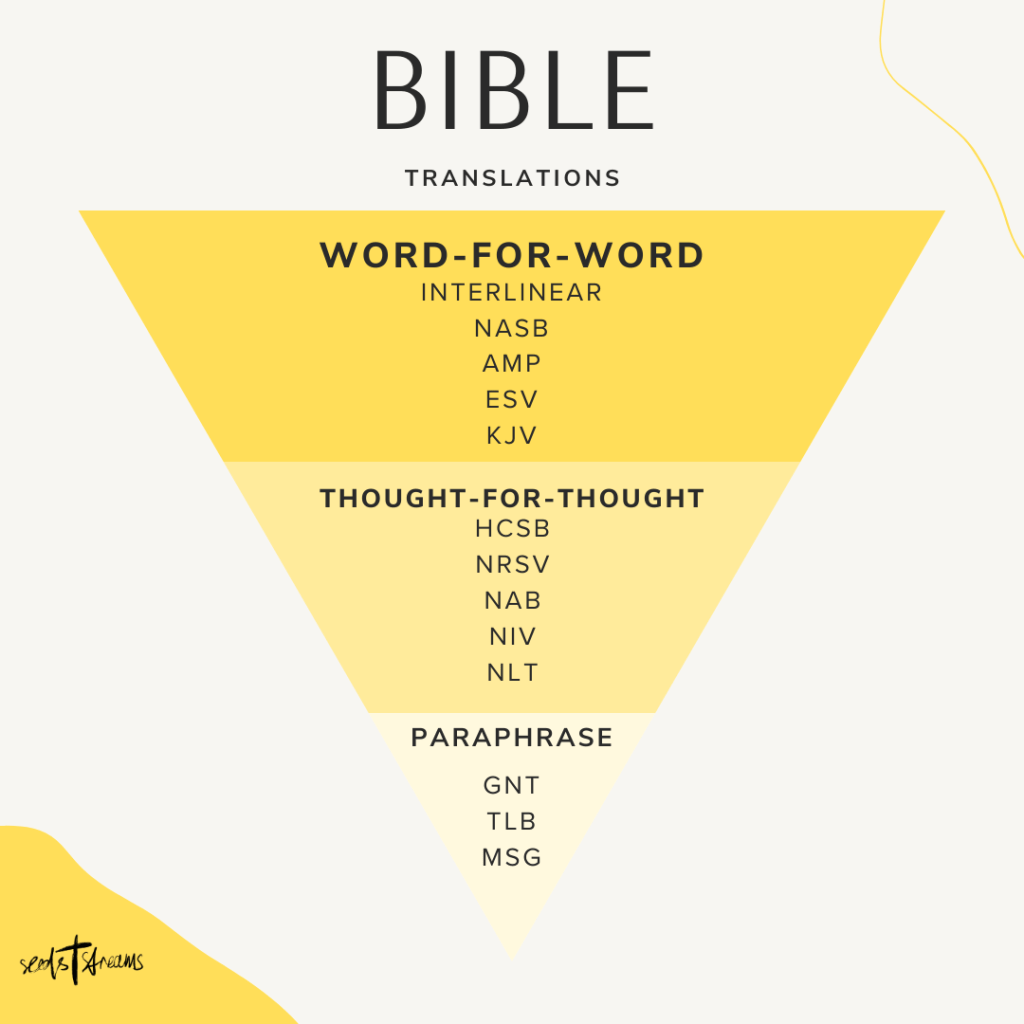
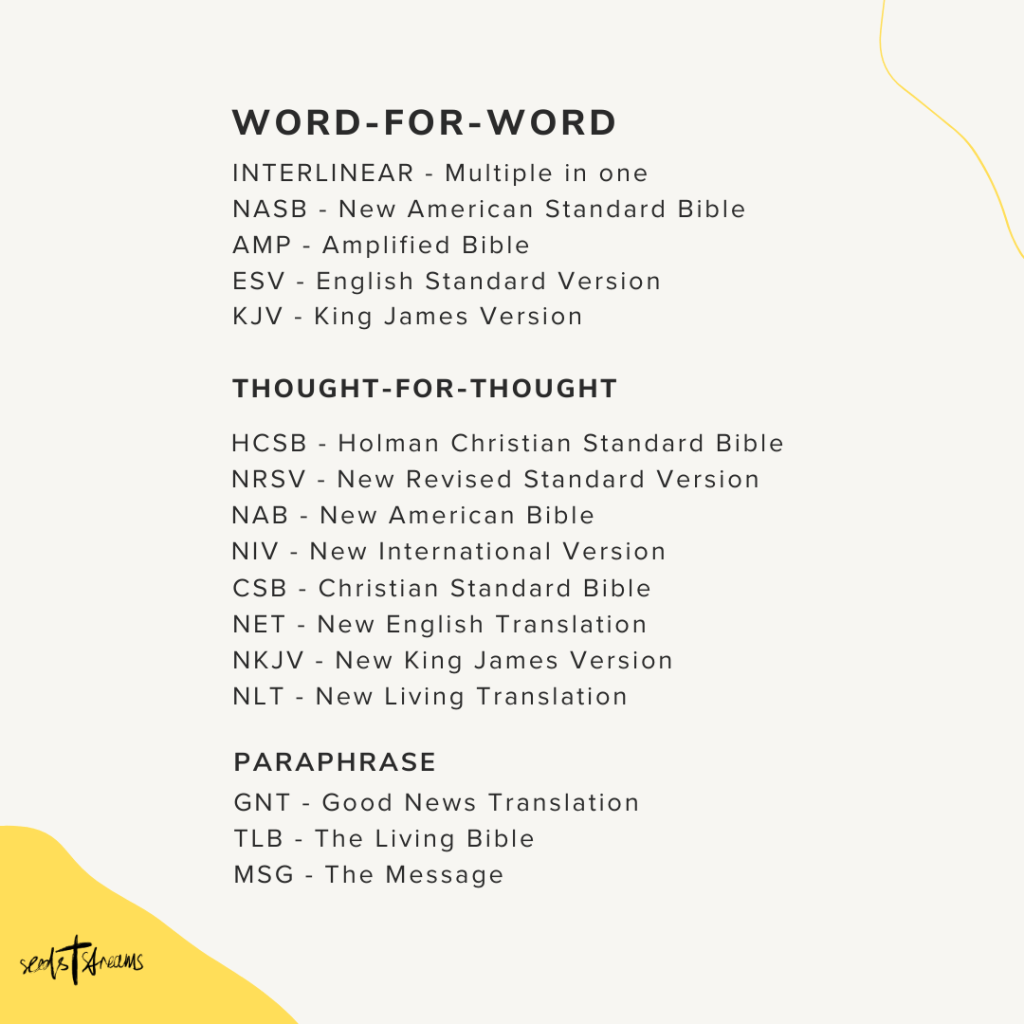
For this reason, it’s helpful to know a little bit about the translation philosophy that your Bible translators used in their process. The above video mentioned 2 main approaches, ‘Word for Word’ and ‘Meaning for Meaning’, but there is a third approach not mentioned called ‘Paraphrase’ which is not considered a ‘translation’ in the pure sense of the word (I’ll put a chart below showing which Bibles are which types).
Translation Philosophy
The Translation philosophy is the way that the translators approach their task, some want to try and convey the form and specificity of each word in the original text, hence they produce word for word translations. These are the most accurate translations for studying the Bible as each word is meticulously chosen, usually by a group of scholars working together. Examples are the ESV and NASB.
The second type of translation is done by looking more at groups of words, and looking for the meaning within the text or the thought behind the text. These are meaning for meaning or thought for thought translations. These translations are often easier to read as they are designed to flow better in English than the word for word versions do. This means the translators must make decisions about the structure of sentences and use of words that may deviate ever so slightly from the original text, while not deviating from the original meaning. These Bibles make a great companion to word for word translations as they can often help the reader to grasp difficult concepts within the text due to the use of simplified language and structure. Examples are the NIV and NAB.
The last group of Bibles is Paraphrase Bibles, and they’re not included in the video above, this is likely because they are not deemed as ‘translations’ by scholars, as translations are the work of converting the ancient languages into a new/different language, and paraphrases don’t do this. Instead of word for word, or thought for thought, they are more like paragraph for paragraph, trying to capture the ideas and concepts within bulk text, and rewrite them in modern or contemporary language. While many paraphrases will still consult the original texts, they’re often relying more on existing translations and their own personal interpretations. These are often the work of individuals, and while they may be instructive, helpful, and poetically beautiful to read, they should be treated more like sermons or commentaries, ie the words of men, and not the Word of God, as they are usually far removed from the original Greek and Hebrew. Because these are the work of individuals, there are loads of them around, and most of them are not very good, and certainly shouldn’t be used as your daily reader or study Bible. An example of a useful paraphrase is Eugene Peterson’s ‘The Message’, and for some, The Passion (but with a caution – explained below).
There are also what scholars call ‘Hybrid’ translations. These are thought for thought translations that border on being a paraphrase. But instead of being the work of one person, these are produced following the same methodology as thought for thought translations. They are usually even more simple in language and readability, but do not deviate into creativity to the point that paraphrase Bibles do. An example of a Hybrid Translation would be the NLT.
What about the Passion Translation?
This is an increasingly popular, yet potentially controversial Bible. The controversial issue is the use of the word ‘translation’. Based on the definitions above, the Passion is simply not a translation. It is more suitable to view the Passion as a ‘Bible Paraphrase’ because of the philosophy and methods underpinning it’s compilation. This is why knowing how Bible translations come into existence and the philosophy behind their work is super important for those who believe in the authority of God’s Word. The Mirror Bible is another example of a ‘translation’ that is really just a paraphrase (but not one I’d recommend)
Should you read The Passion Bible?
The Passion Bible does have value as a paraphrase, even more so for those who are familiar with the scriptures and are able to discern the word of God from the creative words of Brian Simmons. It does stir your heart and inspire you. It does put a lot of complex things into simple, accessible language. It does claim Jesus to be the only way to salvation, and much like the words of a gifted preacher, it does edify the believer… but it is not a ‘Bible Translation’ in the pure sense and should be read partnership with a word-for-word or thought-for-thought translations.
Recommendations
As a daily reader, for your reading plan or morning/evening devotions, a word for word is best, but some may find that a thought for thought translation is an easier and more fluid reading experience. For actually studying the Bible & for personal spiritual growth, go with a word for word translation, if you’re preparing a sermon or message (or leaving a small group or Bible study), read a variety! And just like the Bible Project video above said, read as many different translations as you can to get a well rounded understanding of what the original authors were trying to say.
What’s your favourite translation & why?
Discover more from Seeds & Streams
Subscribe to get the latest posts sent to your email.
