There’s something sacred about opening the Bible. Not because the paper is holy or the ink carries magic, but because Christians believe that through these words God has chosen to speak; clearly, faithfully, and for every generation. As Paul told Timothy, ‘all scripture is God-breathed’ (2 Tim 3:16). That’s why translation matters.
When we read Scripture in English, we’re trusting that careful hands have carried the meaning of the original Hebrew and Greek across centuries without adding to it or taking away from it.
Recently, however, a translation called The Passion Translation (TPT) has gained enormous popularity in charismatic and devotional circles. Many people testify that it feels powerful, fresh, even life-giving. But feelings are not the measure of accuracy, especially when we know that the heart is deceitful above all things (Jer 17:9).
It’s also even more pertinent to be alert in these Last Days (which began at Pentecost) since we’re told that ‘the time will come when men will not tolerate sound doctrine, but with itching ears they will gather around themselves teachers to suit their own desires’ (2 Tim 4:3).
Just because something feels good and sounds right, doesn’t mean it is. We must have a more enhanced set of skills in discerning truth from error, and that begins with translation.
Shepherds have always had to ask a hard questions relating to doctrine, and concerning the TPT one must ask: Are these truly the words of Scripture, or are they the interpretations of a teacher placed inside the text itself?
In the pages that follow, we’ll step back from the hype and listen carefully to the voices of scholars who work daily in the languages of the Bible. Their conclusions are sobering, and for those who care about guarding the Word entrusted to the church, they deserve careful attention.
Christians have never believed that guarding the Scriptures means accepting every new claim uncritically. From the earliest centuries of the church, believers have tested teachings, texts, and interpretations with careful scrutiny.
Jesus himself predicted false prophets and false teachers, and even within the Apostles’ letters we find them defending against heresy and warning against false teachings that were already emerging. What’s more, we find Jesus in his letters to the seven churches in Revelation rebuking certain churches on the basis of the teaching they tolerate or fail to correct (See for example, Matthew 7:15, 24:24; Romans 16:17-18; 1 Corinthians 15:33-34; Galatians 1:6-9; 2 Peter 2:1-3; 1 John 4:1; Revelation 2:14-15)
The councils of the early church wrestled publicly with doctrine so that the faith handed down from the apostles would not be distorted. The great creeds emerged from that process of testing and clarification. Centuries later, the Reformers called the church back to the authority of Scripture itself, examining translations, manuscripts, and doctrines in the light of the original languages, establishing Sola scriptura (“by Scripture alone”), the 16th-century doctrine asserting that the Bible is the sole, infallible, and final authority for Christian faith and practice. It teaches that Scripture is sufficient for salvation and supreme over church traditions, councils, or popes, which are considered subordinate. If this is what we, the church, believe about scripture, then we want to be absolutely certain the English versions we are reading are a faithful, accurate and reliable translation of the originals.
In other words, the careful work of textual criticism, doctrinal consensus, and translation review is not modern skepticism, it is part of the church’s long tradition of faithfulness. When we pause to examine a ‘translation’ like TPT, by Brian Simmons, we are not attacking Scripture, or Simmons; we are doing what Christians have always done: holding every teaching and every rendering of the Bible up to the light, so that the church may continue to hear the voice of Christ clearly rather than the echoes of human interpretation.

The core question we must answer
Is the TPT an accurate and reliable translation (in any normal scholarly sense), or is it a paraphrase/commentary presented as a translation? And if so, is the author/translator being misleading or deceptive in how they present it?
If it’s a paraphrase, it may have some devotional use, with heavy warnings and clear labeling.
If it’s presented and used as a reliable “Bible,” but functions as one man’s interpretive expansions, then the shepherd’s duty is to say: this will train sheep to confuse Simmons’ voice with the Spirit’s voice in Scripture.
That’s the critics’ drumbeat; Is it faithful, or is it misleading?
Spoiler:
The critics, who come from a variety of traditional and theological backgrounds, are unanimous in their warnings against the TPT. We should humbly heed their learned warnings.
My repentance.
When the TPT first came on the scene, I along with many others found it refreshing and exciting. I was not as critical as I ought to have been in assessing it and found myself recommending it to others. I had the whole collection and had copies of it in my house. Over time, I came to find more and more issues and inconsistencies in the TPT which lead me to dig into it’s translation method and accuracy more closely. That lead me to discover all that I have am writing about and sharing with you.
To those who may have trusted the TPT because I recommended or suggested it, I am sorry. I got it wrong. I ask for your forgiveness.
I have discarded every copy I owned, and removed them all from my house. I have raised my concerns to those in church leadership with whom I have relationships, asking them with a humble heart to carefully reassess and consider the arguments against the TPT.
I am grateful for the hard work of those academics above, and for Mike Winger for pushing ahead with the Passion Project. Thank you for loving God enough, and his church enough, and the Scriptures enough to make all this research available to us for free.
What follows is slightly more academic in style compared to my usual articles. It’s written for all, but geared towards church leadership and pastors. Now, let’s dive in to this analysis of the TPT.
We must consider the critics’ credentials, consensus, and why they carry weight.
First, we need to thank Mike Winger of Biblethinker.org for his hard work in his ‘passion project’. Winger paid a variety of scholars from difference traditions, to write academic reviews of individual books from Simmon’s TPT. These scholars were to be unbiased and professional in their work. Their articles are available in the bibliography, and Winger also interviewed them on his YouTube Channel so they could explain their findings in a more conversational setting. I highly recommend you check it all out as I have, if you desire to dig deeper. I’ll also present the findings of other scholars outside of Wingers work.
The strongest critiques of the TPT come from scholars whose vocation is languages, exegesis, textual criticism, and translation method; the disciplines directly relevant to evaluating a “translation.” Let’s take a survey of those who reviewed the TPT for Mike Winger.
Darrell L. Bock (PhD) — Reviewed the TPT’s version of Ephesians
Credentials: Senior Research Professor of New Testament Studies, Dallas Theological Seminary (NT scholarship/Greek-based exegesis).
Bock’s opinion: The TPT should be treated as a single man’s paraphrase, not a reliable translation:
- “I will treat this as a paraphrase and not a translation, because it is NOT a translation… This rendering is only a paraphrase, at best. That is an issue already with how this text is presented”
- “The appeal to Aramaic manuscripts for a Greek text makes no sense to me…”
- “Claims that there are fresh readings there that are legitimate are an exaggeration of the work’s quality and misrepresent the original Greek text.”
- Repeatedly Bock notes throughout his review of Ephesians that Simmon’s work includes things that are simply ‘not in the text’
Pastoral implication: If the method itself is confused (Aramaic appeals for Greek epistles), pastors should not let it function as a primary pulpit Bible, or reference for discipleship and study. If a quote from the TPT is used in a sermon, short message or discipleship material, it can be easily interpreted as an endorsement of the whole text as being reliable. For the uninitiated this can be problematic and dangerously misleading from a theological point of view.
Douglas J. Moo (PhD) — Reviewed the TPT’s version of Romans
Credentials: Widely respected NT scholar; chaired the Committee on Bible translation (NIV), and Wessner Chair of Biblical Studies, Wheaton College
Moo’s opinion: The TPT is unreliable as a guide to meaning; not suitable as the “Word of God” for believers.
- “I applaud the obvious deep concern expressed in this translation and its explanatory documents to bring the Word of God alive to a new generation. However, I find it has several problems that, together, mean it is an unreliable guide to the meaning of Scripture..”
- “In Romans 3:24, for instance, the translation reads, “His gift of love and favor now cascades over us.” “Grace” is found here in the original, but there is no reference to “love” in this context. These kinds of additions are found everywhere. More problematic additions, however, are those that may shift the meaning of the text. In Romans 8:14, for instance, the translation has, “The mature children of God are those who are moved by the impulses of the Holy Spirit.” “Mature” has no basis in the Greek text, and by adding this qualifier, the verse is turned from a promise to all believers (which it is in context) to a promise limited to certain kinds of believers.”
- “…what is happening here is that a text that no significant part of the church has ever viewed as inspired is being used to communicate the Word of God in English. This alone, in my view, renders this translation unusable by those who want to access God’s Word.”
- “I would counsel believers not to use The Passion Translation as their Word of God.”
- Moo lists and expands on the following problems: “Confusing translation Philosophy, Inconsistencies, Textual Basis, False appeal to etymology, Questionable Interpretations, Challenges to Meaning based translations, and The problem of the ‘one-man-band’.
Pastoral implication: Moo isn’t saying “never read it.” He’s saying: don’t treat it as Scripture, and make sure those in your church know not to treat it as scripture. Quoting the TPT should be considered similar to quoting any other author, like C.S Lewis or Tolkien, but should not be viewed as quoting scripture by any means.
Nijay K. Gupta (PhD) — Reviewed the TPT’s version of Galatians
Credentials: Professor of New Testament, Northern Seminary (Greek epistles, Pauline studies).
Gupta’s opinion: The TPT is “Targum-like” (translation + interpretive expansion) and not fit for “official use” as Bible.
- “TPT is a misleading, inaccurate, and overall “bad” translation if it was intended as an “official use” Bible. But no, it is not necessarily a “bad” translation if it is designed as a help or tool for understanding the Bible”
- “TPT strikes me as Targum-like.” (Jewish commentary of Torah)
- Is Brian Simmons qualified to write an “official use” Bible translation? No—for a number of reasons… Perhaps most troubling, is his insistence on “using” Aramaic texts as the most accurate biblical texts. Now, virtually all scholars and academic Bible translators (including myself) believe that Paul wrote his letters in Greek. It is odd and misleading for Simmons to appeal to Aramaic originals
- Overall, I found TPT’s translation of Galatians occasionally thoughtful, but largely haphazard and “amateur” in its translation techniques. It lacks a consistent translation method, and does not take into account major trends and agreement in Galatians biblical scholarship. Many of the additional flourishes and interpretive glosses that TPT includes are misleading and/or overly speculative. Overall, I take TPT’s Galatians as the personal opinion of a missionary—which may have some value in its own right—rather than a consistently accurate “translation” of the Greek text of Galatians for serious use.
Pastoral implication: Galatians is our “gospel clarity” epistle, it’s where we turn to when we want to be reminded of the pure Gospel of Grace when tempted to return to works based faith. When we need to course correct, the last thing you want to do is hand people a text that blends translation with a running interpretive sermon, then call it “Bible.”
Tremper Longman III (PhD) — Reviewed the TPT’s version of Song of Songs
Credentials: Distinguished Scholar and Professor Emeritus of Biblical Studies, Westmont College.
Longman’s Opinion: The Passion Translation of the Song of Songs is not a translation, but at best, an interpretive paraphrase. TPT imposes allegory and invents content not in the original Hebrew.
- “This represents nothing in the Hebrew text and is pure invention.”
- The reason why precious few people take the Song as an allegory today is because it has become clear that there are no indications in the Song itself that it is an allegory… it is clearly a love poem.
- he commits what is commonly called the etymological fallacy, which is looking at root etymology to discover a word’s meaning
- He will sometimes use the Septuagint (Greek) as a source for his translation instead of the Hebrew. Now there are, sometimes, good textual reasons to do this, but in this case there are none
- he will cite authorities to support his ideas, but in ways that we cannot follow up on. He uses phrases like “some scholars” or “some Hebrew scholars.” By not telling us who, we can’t evaluate whether they exist, or if they do, whether they are competent modern scholars.
- The Passion Translation is a deeply flawed presentation of the Song of Songs. Its imposition of an allegorical interpretation represses the primary meaning. One can’t hear God’s intended message in this translation.
- 1:2 “. . . his Spirit-kiss divine.” This represents nothing in the Hebrew text and is pure invention.
- 1:4 “. . . into the king’s cloud-filled chamber.” There is nothing to justify this in the Hebrew
- 1:8 “. . . just follow in my footsteps where I lead my lovers. Come with your burdens and cares. Come to the place near the sanctuary of my shepherds.” This is his translation for “follow the tracks of the sheep, and feed your young goats by the dwellings of the shepherds.”
- Longman continues to offer verse by verse analysis of the entire book.
Pastoral implication: If a “translation” re-writes genre (love poetry into devotional allegory) inside the Bible text, that is not translation, it’s doctrinal steering. It is clear that Simmons approaches the text with a goal, a direction and objective in mind, and being true to the original text is not it. This presents as sectarian, steering the reader toward a very specific and misguided view of scripture, and of God.
Craig L. Blomberg (PhD) — Reviewed the TPT’s version of 1 Corinthians
Credentials: Distinguished Professor of New Testament, Denver Seminary, Littleton, CO.
Thesis: It is not a translation in standard usage; it routinely adds clauses/phrases.
- “Despite the title, it is not a translation by any standard usage of that term…”
- Simmons does claim that, whenever he inserts something that doesn’t correspond to the ancient Greek (or Hebrew), he puts the English in italics. Unfortunately, he doesn’t follow through on this pledge with any consistency. On numerous occasions, such insertions are not italicized at all.
- In 11:4, 5, and 6, the paraphrase inserts language that limits the men and women being discussed to leaders—a limitation that is patently not in either the text or its context.
- Instead of the Spirit distributing his gifts to believers as he sees fit (12:7), TPT insists that “each believer is given continuous revelation. . .” Even if this expression is taken more along the lines of spiritual illumination, it still does not provide a promise of anything constant, while many gifts of the Spirit (e.g., giving, helping, administration, faith) really don’t have anything to do with revelation at all.
- Consistently throughout the entire “translation” of the New Testament, Simmons referees to what the Aramaic says and how it would be translated, despite the fact that there are no ancient Aramaic versions of the New Testament. Every book of the New Testament. Every book of the New Testament was written originally in Greek and in no other language.
- for someone who isn’t already familiar enough with Scripture to sort the original from the overlay, this version will prove too misleading for it to be recommended
Pastoral implication: 1 Corinthians is precision theology on spiritual gifts, love, resurrection, church order and the proper conduct of believers. Raising mature believers depends on helping them discern right and, by rightly dividing the Word of God. This, of course, starts by having an accurate translation of the The Word of God.
Alex D. Hewitson (M.Div. candidate at time) — Reviewed the TPT’s version of Colossians
Credentials: BCom, PGDA (University of Cape Town); CA(SA)
Master of Divinity Candidate (Westminster Seminary California).
Thesis: The scale of expansion alone disqualifies it from being a translation.
- Most major translations are the result of careful, long-term work by dozens of scholars who have spent years wrestling with translation philosophy, textual choices, and other issues. However, the more work I completed on this project, the more evident it became that TPT is not a translation of the Bible in any meaningful sense. On that basis, I am comfortable presenting this critical review to bring attention to the dangers that TPT poses.
- “…TPT is not a translation… in any meaningful sense.”
- “major English translations… contain between 20% (ESV) and 32% (NASB) more words than the Greek text. By comparison, TPT has 81% more words than the Greek text… and 51% more words than the ESV.”
- Simmons is therefore inaccurate when he uses the phrase “the Aramaic reads…” in his footnotes. Instead, it should be “the Syriac reads…” Further, from studying the footnotes, there is no evidence that Simmons actually knowsanyAramaicorSyriac. Instead, it seems that he simply inserts ideas from Andrew Gabriel Roth’s translation of the Peshitta when they seem interesting to him or helpful in making his point.
- All those extra words mean something: Simmons adds adjectives not in the Greek, changes adjectives, introduces compound phrases, changes verb phrases, changes verbs into nouns, adds nouns, converts nouns into compound phrases and alters verbs completely, as well as creates radical expansions, where, for example in 1:6, “as it is among you” becomes “Every believer of this good news bears the fruit of eternal life as they experience the reality of God’s grace.” And in 1:8, “your love”becomes “many wonderful ways love is being demonstrated through your lives”
- Simmons regularly alters the translations of difficult passages or concepts.
- The phrases, “abounding in thanksgiving” (2:7) and “concerning things which all perish with consumption” (2:20) have been completely removed
- Simmons has made significant linguistic and theological alterations, even importing foreign ideas into the text. Despite Simmons’ claim that he is a linguist and translator, a close evaluation of his translation work casts serious doubt on this assertion.
- Simmons, however, claims that TPT is an accurate and clear translation to be used for preaching and serious study. It is not. Simmons’ objective of representing the “fiery heart of God” results in a translation approach that is substantially a hermeneutic, rather than a method. While many people may believe that they are reading the Bible when reading TPT, they are in fact often receiving personal teaching from Simmons rather than Scripture. Unfortunately, the end result of Simmons’ work is not Christian Scripture, but an unduly free and sectarian translation that is not suitable for either public ministry or private devotion
Pastoral implication: Colossians warns against distortions and “philosophy” that displaces Christ; we don’t want to promote or endorse the use of a Bible version that normalises “meaning-by-expansion” as if it were apostolic wording. If ‘you shall know the truth and the truth shall set you free’ is our confident belief, then the TPT is not delivering that Truth but a version of it that is skewed.

Wesley Huff
Credentials: Vice President for Apologetics Canada. He holds a BA in sociology from York University, a Masters of Theological Studies from Tyndale University, and is currently doing a PhD in New Testament at the University of Toronto’s Wycliffe College.
Huff has shot to fame in the last few years, speaking at seminars, conferences and Christian events, and more so after debating Billy Carson. Since that debate Huff has been a guest on popular podcasts like the Joe Rogan show, and the Sean Ryan Show. He also recently produced a fantastic documentary on YouTube titled ’Can I Trust the Bible’; highly recommended.
Huff has a great article on the History of Bible translations here. In that article Huff states that ‘in many ways “translations” like TPT or the Mirror Bible are more problematic than even the sectarian translation of the NWT”. For those wondering, the NWT is the New World Translation used by the Jehovah’s Witnesses.
Concerning the NWT Huff writes, “Due to the sectarian bias of the JWs in conjunction with the lack of true biblical scholarship among the group, this is easily the worst English translation available”.
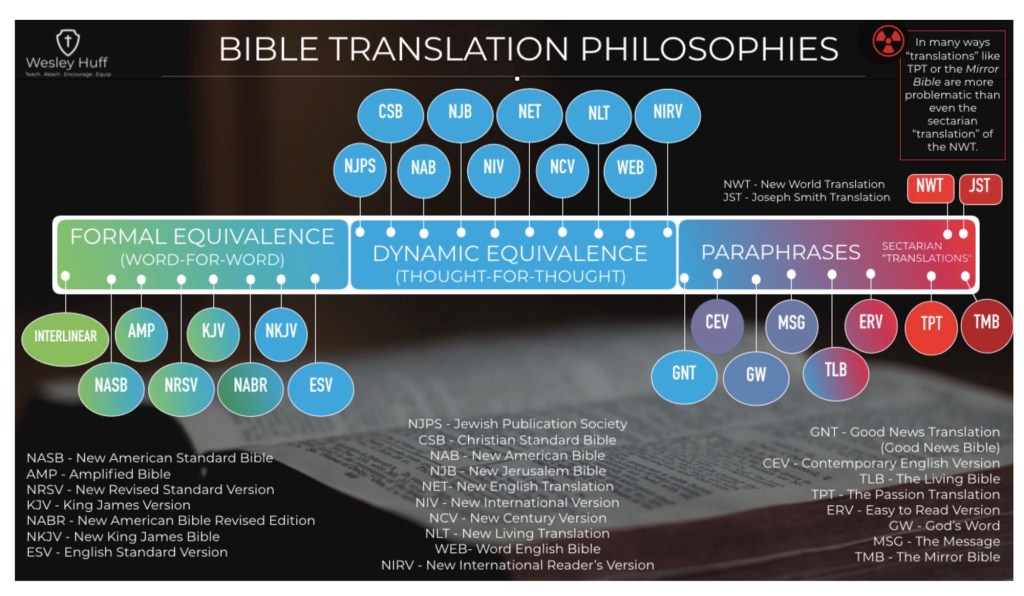
If Huff thinks (rightly) that the JW ‘Bible’ is the worst, and that the TPT is potentially even more problematic, that alone should give us cause for concern. But with all the critics reviews we’ve looked at so far, Huff’s opinion is hardly surprising.
Additional reputable critiques
Andrew G. Shead — Reviewed the TPT’s version of Psalms on Themelios
Credentials: Moore Theological College; translation committee involvement is commonly noted (NIV circles).
Read Shead’s article here.
Andrew Wilson — Article: “What’s wrong with the Passion ‘Translation’?”
Credentials: Teaching Pastor at King’s Church London, and has degrees in history and theology from Cambridge (MA) and King’s College London (PhD).
Read Wilson’s article here.
Lionel Windsor — sustained textual critique of Romans.
Credentials: Bachelor of Engineering (UNSW), Bachelor of Divinity and Diploma of Ministry (Moore College), Master of Theology (Moore College, PhD (Theology), Durham University, UK. His PhD studies had a Pauline focus with an emphasis on Romans.
Read Windsor’s article here.
Why this matters:
The critique of the TPT is not one denomination’s axe to grind; it’s a multi-source convergence and unanimous agreement: this is not how translation is done.
The defenders
Who they are, what kind of authority they offer, and what they don’t
A. Brian Simmons (lead translator)
What he offers: a “heart-level” Bible reading experience and claims of special commissioning. There are multiple reports and transcripts circulating that he claimed Jesus commissioned him to translate and promised him “secrets” of Hebrew / revelatory “downloads.” He even claimed to go to Heaven’s library where one day he would be allowed to bring back John 22. (Winger has multiple video clips available of Simmons making these claims)
What he does not offer (as publicly evidenced):
- Recognized advanced academic credentials in biblical languages, textual criticism, or translation studies comparable to the translators on major committee Bibles.
- Transparent committee accountability (the ordinary guardrail against one person’s theology becoming the text).
- Although he claimed to have done translation work, the missions agency, ‘New Tribes Missions’ that he worked with came out recently claiming that he never did translation work while with them (https://biblethinker.org/is-brian-simmons-qualified-to-make-the-passion-translation/ )
Even sympathetic readers should see the structural risk: a one-man translation with revelatory claims is almost designed to blur the line between “Scripture” and “private interpretation.”
Does he love Jesus? It would certainly seem that he does. Is he a reliable source for Bible translation? No.
B. The endorsement ecosystem (Bethel / celebrity-charismatic leaders)
TPT’s endorsements are dominated by pastors, revival leaders, and movement figures, not specialists in translation method or scholarly work. For most books, a reputable pastors endorsement is great, but for Bible Translation we need to rely on the experts.
Bill Johnson (Bethel Church)
What he offers: spiritual/pastoral endorsement. Bill said the TPT is the “best thing to happen in Bible translation”.
What he lacks: public evidence of specialization in Greek/Hebrew translation work.
Credibility stress-test: Recently, Bethel leadership publicly apologized to victims connected to Shawn Bolz, referencing “sexually harassing culture,” and addressing the fallout of “prophetic words” people acted on. This public apology was the result of mounting pressure from public exposure. They had known about it for years and failed to address it in a biblical manner.
Even after being aware of Bolz’s fraud and misconduct, prior to being exposed, Johnson went on TV and endorses Bolz new book, commenting on the character of the author being highly admirable.
This matters because TPT’s strongest advocates and defense often functions like:
“Trusted prophetic leaders endorse it, therefore it’s safe.”
The TPT website even has a video of Bill Johnson on the homepage endorsing the TPT and encouraging people to buy it.
But if the same ecosystem admits failures around fabricated prophecy and cover up culture surrounding sexual misconduct and abuses in leadership, then certainly their endorsements are weakened.
Can the opinions of leaders who cover up fraud and gross misconduct be trusted?
It seems the only people I can find who defend the TPT are those who have accepted it based on the approval of Bill Johnson, and those ministers who move in similar circles (or want to). I could not find any respected Bible scholars or translation experts who back the TPT as credible.
One pastor I had several conversations with about the TPT, when I raised my concerns, asked me “so you think you know better than Bill Johnson?” That rhetorical question was an attempt to shut down the conversation by appealing not to Johnson’s academic or scholarly work, but to his influence and reputation as a Charismatic Leader, a reputation that has since gone up in flames.
Patricia King and Che Ahn are both listed on the TPT endorsement webpage, and both are involved in the Bethel/Bolz cover up scandal.
What this points to is an ecosystem, a network, of relationships where friends cover up for friends, and leaders promote each other’s work to help each other out, even if it’s a ‘translation’ of the bible.
Others listed as giving their endorsement of the TPT include well known pastors, authors and conference speakers; Lou Engle, Bobbie Houston, John and Lisa Bevere, Heidi Baker, and others, but none of them seems to have specific qualifications related to translation expertise, and all of them appear to part of the same relational network with Bethel Church, and IHOPKC.
IHOPKC network influence
While IHOPKC was not involved in the translating or directly promoting the TPT, it is part of the broader charismatic ecosystem where TPT has been widely embraced.
IHOPKC publicly announced the release of an independent investigation report concerning allegations of abuse against founder Mike Bickle. It’s not pretty.
Again: this alone does not logically prove TPT is wrong, but it does show why pastors should not treat endorsements by celebrity pastors as automatically reliable. If cover up and abuse is happening behind the scenes, the credibility of these leaders and any endorsements they make become highly questionable.
A repeated critique of the TPT is that it is sectarian in nature. That is, it appeals to and seems to support the views and bias of a particular group of Christians. That group is those like Bethel, IHOPKC and other NAR style charismatics, so much so that many outside of their influence may not have even heard of the TPT!
Michael W. Smith has removed his endorsement of the TPT, and Biblegateway.com has removed the TPT from its list of about 50 English translations it offers free on the website. The YouVersion Bible App has not yet followed suit.
The Joseph Smith / Muhammad parallel
This is not an insult by comparison, but an analysis of what is called an “authority mechanism”.
The authority mechanism refers to that which someone claims gives them the right to something. A Policeman refers to the laws of the government as the mechanism that grants him authority to arrest someone.
A classroom teacher refers to the school rules as the mechanism that grants them authority over the students in the classroom.
As Christians, the scripture is our authority mechanism. It is what we turn to for the final decision.
A recurring pattern in alternative-scripture movements is that the authority mechanism is places somewhere that other people, lay people, cannot access or inspect. This is typical in cults.
- A figure claims special divine/angelic commissioning to restore lost truth, or to recover hidden/secret truth.
- That figure lacks (or bypasses) ordinary public checks, peer review, language transparency, historical controls, evidence.
- The product is presented as God’s words, replacing what was previously considered God’s Word. (This is where the Islamic Paradox comes in. The Koran affirms the Gospel as true, but then claims Jesus never died, denying the witness of the gospel. So if the Koran is true, then the Gospel is true. If the Gospel is true, then the Koran is false). New ‘revelation’ always seeks to usurp truth.
- Followers are trained to trust the new product based on the revealer’s authority, not on its ability to be tested.
- The authority mechanism becomes an elaborate form of, “trust me, God told me this is true but there’s no way you can check for yourself.”
The authority mechanism is out of reach, and cannot be interrogated or questioned with logic, reason, history or archaeology; the very things the Bible is always strengthened by.
This moving of the authority mechanism shows up in Mormonism and Islam.
- Joseph Smith’s “translation” authority claims cannot be tested, since his new revelations came from magic stones to help him translate the Book of Mormon… but now they’re gone.
- Muhammad claimed to receive revelation mediated as divine speech when he was visited by an angel. The revelation was dictated to him, even though he was illiterate, it was eventually recorded by his writers. Again, it can’t be tested.
- And, in a smaller but structurally similar way, when a Bible “translator” claims Jesus commissioned him and gave him “secret downloads”, he is not accountable to public linguistic methods. Simmons claims divine help, even angels, and that God ‘expanded his brain capacity’, none of which can be tested or measured.
- The repeating line in all these authority mechanisms is; “Trust me bro, I’m a pro”
Pastoral warning
The New Testament pattern for doctrinal safety is public, tested apostolic teaching, not private “secret” access:
- The Berean model tests claims by Scripture (Acts 17:11).
- The church tests prophecy and teaching (1 Thess. 5:21; 1 John 4:1).
- Teachers are judged more strictly (James 3:1).
So when a project’s credibility leans on revelatory commissioning rather than demonstrable textual fidelity, pastors should hear alarm bells, not because God cannot guide, but because this is exactly how sheep get trained to accept authority without verification.
A strong case against using TPT especially in teaching and preaching
A. It collapses the line between translation and interpretation
This is the consistent scholarly verdict:
- “NOT a translation.”
- “not a translation by any standard usage…”
- “Targum-like.”
Pastoral harm: people won’t know where Scripture ends and Simmons begins. And if it’s used from the pulpit, the congregation will get the idea that the TPT is acceptable and reliable alongside the NLT or NIV.
B. It uses (or at least markets) “Aramaic” in a way scholars say is methodologically wrong
- “The appeal to Aramaic manuscripts for a Greek text makes no sense…”
Pastoral harm: it suggests hidden authority, the TPT effectively is saying that “the Aramaic reveals what your Greek Bible missed”, which trains suspicion toward mainstream translations and fosters a “special knowledge” appetite.
C. It expands the text at a scale inconsistent with translation
- “81% more words than the Greek text.”
Pastoral harm: it habituates readers to expect the Bible to sound like a devotional commentary, not like Scripture. It makes everything dramatic and exciting when not everything needs to be.
D. It’s propped up by endorsements that are not scholarly validations, and come from credibility-stressed ecosystems
- TPT endorsements are overwhelmingly movement leaders.
- Bethel acknowledged failures in handling Shawn Bolz’s harmful culture and misleading prophecies, reducing their own credibility, and those in their circle.
- IHOPKC publicly acknowledged an independent investigation report concerning Mike Bickle allegations, and many of those on the TPT Endorsement page are associated with both Bethel and IHOPKC.
Pastoral harm: when “trusted voices endorse it” becomes a shortcut for discernment, we train people to bypass critical thinking and Berean diligence, relying on feelings instead of rigorous scholarly acdemia. And as it turns out, some of these “trusted voices” are not so trustworthy.
E. Senior scholars explicitly advise against using it as “Word of God”
Moo’s counsel is blunt: “I would counsel believers not to use The Passion Translation as their Word of God.”
That is a shepherd’s warning, not an academic squabble. We would be wise not to disregard these academics as merely ‘head-knowledge’ people who do not also love God, his word and his church. These reviews are not about slinging mud, but protecting the sheep.
Pastoral recommendation
If you are guarding doctrine and protecting sheep:
- Do not use TPT as a pulpit Bible, and if you do, tell the congregation exactly what the TPT is and is not. Tell them it’s one man’s commentary, and not scripture.
- Do not make it the “Bible” of a discipleship pathway. Don’t raise people on a commentary, raise them on scripture.
- If someone reads it devotionally, warn them plainly:
- Treat it like a charismatic-flavored devotional paraphrase, not translation.
- Always keep an actual translation open alongside it (ESV/NIV/NASB/CSB/NRSV, etc.).
- Teach your people the difference between:
- translation (serving the text)
- paraphrase (retelling the sense)
- commentary (explaining meaning)
This isn’t quenching the Spirit; it’s loving the flock and equipping them to discern truth from error.
Well, that’s a lot. I’m going to leave it here. I pray this has served you and helped you as you seek to know and honor the Lord, by knowing and abiding in His Word, God bless.
Bibliography of key sources.
Bethel Church. (2026, January 25). An important letter from Bill, Kris, and Dann on behalf of Bethel leadership. https://www.bethel.com/news/an-important-letter-from-bill-kris-and-dann-on-behalf-of-bethel-leadership
BibleThinker. (n.d.). The Passion Project. https://biblethinker.org/the-passion-project/
Bock, D. L. (n.d.). Assessment of The Passion Translation of Ephesians [PDF]. BibleThinker. https://biblethinker.org/the-passion-project/
Blomberg, C. L. (n.d.). Assessment of The Passion Translation of 1 Corinthians [PDF]. BibleThinker. https://biblethinker.org/the-passion-project/
Gupta, N. K. (n.d.). Assessment of The Passion Translation of Galatians [PDF]. BibleThinker. https://biblethinker.org/the-passion-project/
Hewitson, A. D. (n.d.). Review of Colossians in Brian Simmons’ The Passion Translation [PDF]. BibleThinker. https://biblethinker.org/the-passion-project/
IHOPKC. (2025, January 17). Mike Bickle independent investigation report released. https://ihopkc.org/press-releases/press-center/press-releases/mike-bickle-independent-investigation-report-released
MinistryWatch. (2024, February 14). Mike Bickle / IHOP-KC investigations page. https://ministrywatch.com/mike-bickle-ihop-kc/
Moo, D. J. (n.d.). Assessment of The Passion Translation of Romans [PDF]. BibleThinker. https://biblethinker.org/the-passion-project/
Premier Christian News. (2026, January 26). Bethel leadership breaks silence as new claims emerge… https://premierchristian.news/en/news/article/bethel-church-responds-shawn-bolz-accusations
The Berean Call. (2021, February 3). Commissioned by Christ, an Angel Named…Passion? https://www.thebereancall.org/content/commissioned-christ-angel-named-passion
Worldview of Jesus. (2022, August 29). The Passion Translation and Brian Simmons (transcript excerpt on commissioning and “secrets”). https://worldviewofjesus.com/2022/08/29/highjacking-christianity-the-passion-translation-and-brian-simmons/
Discover more from Seeds & Streams
Subscribe to get the latest posts sent to your email.
