Music is powerful. How many memes have you seen of great scenes from movies but the music has been replaced with something absurd? Like someone walking down the isle in Romantic Drama while the Imperial March plays. Or a scene from Gladiator with the theme song from The Beverly Hillbillies. Music really makes a difference.
Right now, I am thinking of Hans Zimmer’s theme from Interstella – it was a masterpiece! But could you imagine Interstella with the soundtrack from The Guardians of the Galaxy? It just wouldn’t work!
Music is as old as time itself. Music bypasses the mind and penetrates our soul, reaching for the heart it pulls and tugs on our emotions like some kind of cosmic sorcery.
Music is so powerful that C.S Lewis, in his Narnia series, portrays the creation of the world being the result of a Divine song sung by Aslan the Lion, the Christlike King of Narnia.
I recall when a very close friend of mine died suddenly. We were all impacted so deeply, so painfully, as we grieved and came to terms with the horrific intrusion. There was one song in particular that ministered to my aching heart, I had it on repeat for weeks, the chorus repeated the refrain, “it is well, it is well, with my soul”. It was gentle, melodic, soulful – not upbeat, not a pop song or dance track. It not only had the right words but the right mood.
Music creates moods, it creates a kind of atmosphere around you, it cultivates emotion and draws us into deep places.
Music is merely the combination and arrangment of notes, by themselves they are often meaningless, powerless and void of any ethical or spiritual meaning. But with the right combination of sounds, tones, dynamics and rhythm, music can move you to tears, make you angry, make you laugh, sing, shout, or feel numb. Music is powerful, both for good and for evil.
Music can lead you places. It can also manipulate you.
There are strong psychological reasons behind the sounds used in a casino. The mechanical sounds of the poker machines, the bells, ringing and dinging, the chimes and alarms… all designed to create excitement like an out-of-town carnival here for one night only – don’t miss out!
Your social media apps do the same thing, notifications chirp away with the sounds most likely to spike your dopamine. Why? In an attempt to manipulate you to stay longer, scroll further, and spend more.
Music is powerful.
And when we sing worship songs to God it is wonderful!
Yet, it’s possible to conflate the high emotional experience music can provide, with the tangible presence of God.
While I would gladly argue that we can feel God’s presence at times, especially in corporate worship and song, it would be wrong to assume that these experiences are the only way to worship.

Sadly, there are many Christians who crave the ‘powerful moments’ in worship but fail to see that these ‘spiritual’ or ‘emotional’ moments are just as easily experienced by fans at a music festival.
Why? Because music is powerful.
But the ‘feels’ is not how we ought to judge the quality of worship.
Worship is worship regardless of whether or not we feel anything or have our hearts or emotions stirred.
Good worship is not the same as good music.
And average music does not automatically mean poor worship.
In the west we have a massive emphasis on excellence. God deserves our excellence. Abel brought an excellent offering. Cain brought left overs.
But in the pursuit of excellence, it is tempting to ditch holy authenticity and replace it with high production.
An over-dependence on production and perfection in Church music can lead people to believe that worship only has value when it moves and stirs us.
But worship does not exist for us!
(God is so good, however, that it is unusual not to feel better after spending time in worship – but that is neither the goal, nor the point, nor is how we feel a good metric for measuring the quality of our worship)
So let’s draw a theological line in the sand; Music, and singing for that matter, is not the same thing as “worship”.
It’s certainly a powerful way to worship, and I myself love to play my guitar and sing to the Lord, and my family has been involved in worship/music ministry for decades.
So don’t hear me wrong, I love worshipping through song and music, and I love the experiential presence of God that we collide with as we sing and make melody to the Lord — it’s incredibly special — but worship is not just music and singing… it’s much, much more.
The Reformation gave us singing

In the 1520’s, in Germany, the now famous Reformer, Martin Luther, introduced singing into his churches. Up until this point, the singing of any songs or Psalms in the church was done only by soloists or the priests. Luther saw the use of song as an effective way to teach the gospel to the laity.
The idea that worship, in the form of singing in church, is something Christians have always done is an invention of the last few centuries.
Yes, the Jewish communities were known for singing together during feasts and festivals, as Jesus and his disciples did at Passover prior to Jesus crucifixion (Matthew 26:30).
But as the Gospel spread to the Gentiles, such feastivals and Jewish customs has less of a focus within the church. By the time the 1500’s rolled around, singing in church was almost viewed as a rebellious act of heresy! Luther was playing a dangerous game indeed. Not only did Luther introduce singing, he did so in the local German tongue, and not in Latin (which only the academic class understood anyway!).
This begs the question; how was worship viewed by faithful Christians prior to Luther’s introduction of corporate singing?
If music and song was not part of the Sunday service, how did Christians worship the Lord? What did they routinely do so that they could confidently say, ‘Look, here is the evidence that I worship Jesus’?
Hebrews 1-12
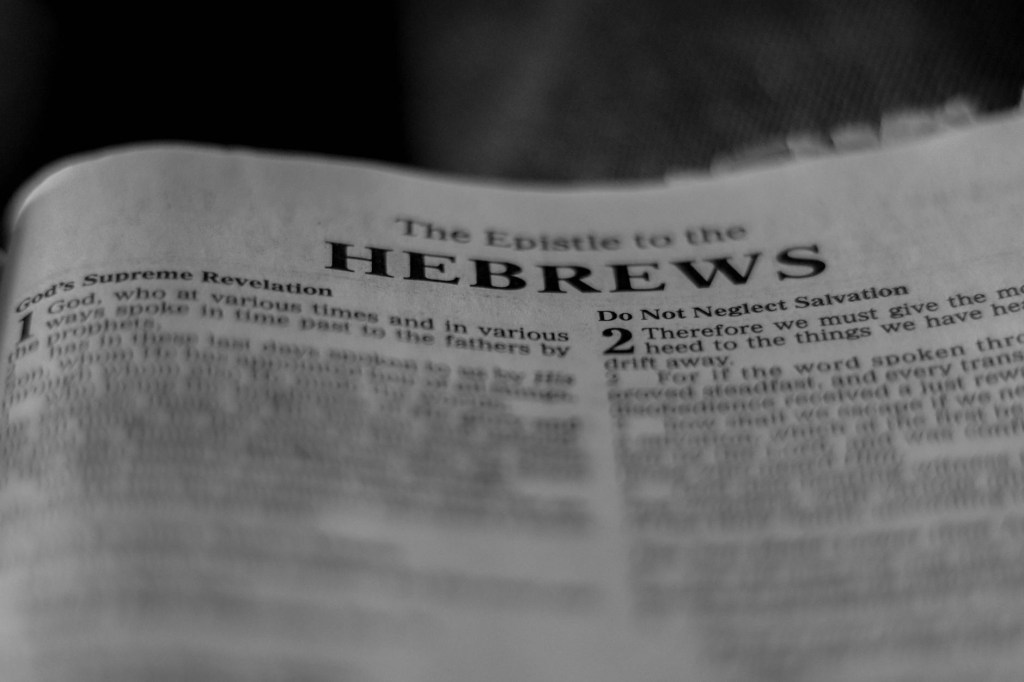
Looking at the Jewish customs of the Old Testament, which pre-date Jesus, can be useful for discovering the many ways that Israel engaged in worship, however, it can only show us how worship was done under the law. So instead of pulling out ‘principles of worship’ from the OT, let’s turn instead to the Epistles, namely, the sermon letter to the Hebrews.
The last 2 verses in chapter 12 of Hebrews reads, ‘“Therefore let us be grateful for receiving a kingdom that cannot be shaken, and thus let us offer to God acceptable worship, with reverence and awe, for our God is a consuming fire.”
The writer of Hebrews has just taken great lengths to talk about the nature of God’s Kingdom being the new ‘Mount Zion’. The author contrasts this new, approachable, eternal kingdom of God by comparing it to the old Mount Sinai when God descended in smoke and fire to meet with Moses, and Israel dared not come near.
This new Kingdom, however, is not one that we keep our distance from, but with bold confident hearts, we can approach the throne of grace with full assurance of being accepted, welcomed and forever embraced by our Father.
For 12 chapters the writer has laboured to show us that Jesus is superior to angels, prophets, the law, Moses… everything! He is God in the flesh who came to save us!
Jesus has fulfilled the law, done away with the sacrificial system, makes constant intercession for us, has redeemed and restored us and now presents us as Holy and blameless in the presence of the Father, inviting us to draw near, to come close, and to do so with absolute confidence knowing that we are beloved and accepted! How Good!!
After explaining this concept, of being able to draw near to God, we arrive at the verse we just read, “therefore [in light of all that I just told you about drawing near to God] let us be grateful for receiving a kingdom that cannot be shaken, and thus let us offer to God acceptable worship, with reverence and awe, for our God is a consuming fire.
Now stay with me…
What comes next is a detailed description, or even prescription, of what this grateful, reverential and awe-filled worship looks like; it’s the application part of the sermon to the Hebrews.
Hebrews 13 – A verse by verse exposition on ‘Acceptable Worship’
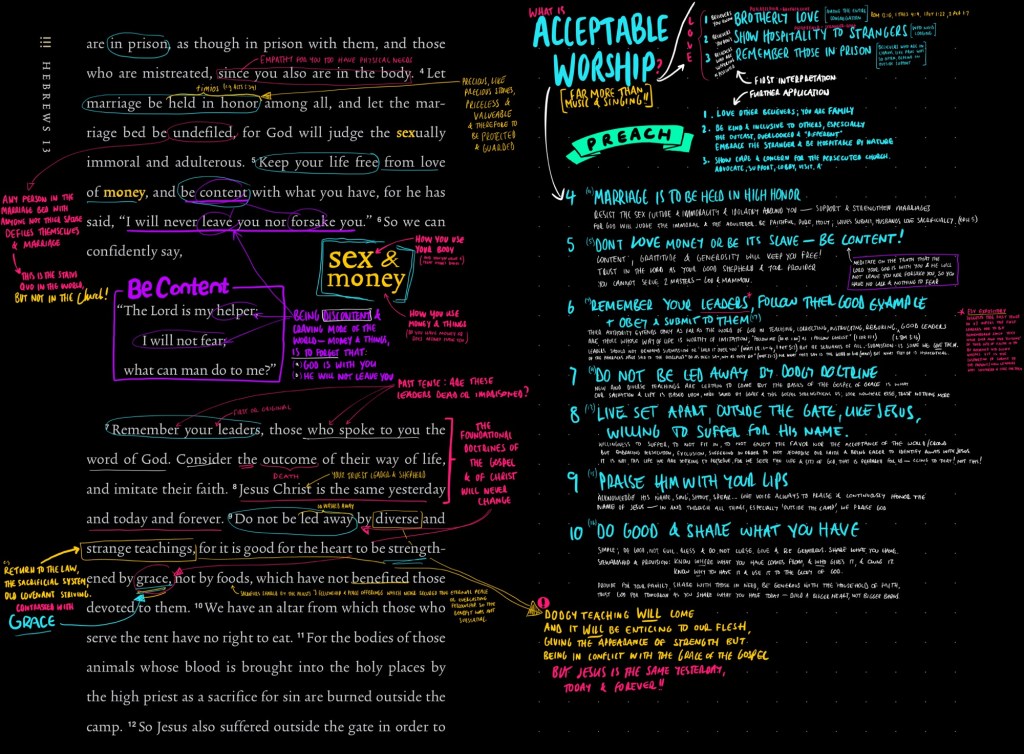
Immediately after the author instructs his listeners to practice ‘acceptable worship with reverence and awe’ he launches into the practical application. There was no chapter or verse when Hebrews was written, so it naturally flows into what we call chapter 13 without skipping a beat.
Hebrews 13:1-21 – this is what a life of worship looks like, and while it actually does include singing; ‘sacrifice of praise, the fruit of our lips’, as we’ll see it includes much, much more.
Let me break it into chunks:
Verse 1: “Let brotherly love continue.
Now may the God of peace who brought again from the dead our Lord Jesus, the great shepherd of the sheep, by the blood of the eternal covenant, equip you with everything good that you may do his will, working in us that which is pleasing in his sight, through Jesus Christ, to whom be glory forever and ever. Amen.”

Philodelphia, the love of a brother. This kind of love is best portrayed by Jonathan loving David. Jonathan was not David’s literal sibling but he loved David as himself, as a true brother, putting David ahead of himself, and supported David in pursuing the call of God. Jonathan was the son of King Saul, next in line to the throne, but he saw David as God did, and loved him even though it cost him dearly. This is love, that you lay down your life for your friends.
It’s the kind of love the older brother in the story of the prodigal son was guilty of not offering his younger brother. He showed no compassion, no forgiveness, no mercy. He was self-entitled, proud, ripped off and bitter.
Brotherly love is the characteristic that identifies a true follower of Jesus. It won’t be our gifts or achievements that convince the world we are disciples of Jesus, but we will be known as true disciples by the brotherly love that we have for one another (John 13:35; 15:8-14).
Our obedience to the command Jesus gave us, to love one another as he has loved us (John 15:12), is our foremost act of worship.
It’s great to sing to the Lord (I love to do it!) but I suspect our songs are of little value to the Lord if we aren’t actively seeking to love each other more and more so that brotherly love continues.
Verse 2: Do not neglect to show hospitality to strangers, for thereby some have entertained angels unawares.

It’s more than likely that the author is not referring to complete randoms. Rather, the ‘strangers’ the Hebrews were to be hospitable to were travelling missionaries, preachers, and messengers of the gospel. This is hinted at by considering the possibility of entertaining angels – messengers – as Abraham did when God visited him.
We should also be open to embracing strangers, being a ‘good samaritan’ and loving our neighbours and enemies, but we are reminded in Galatians 6:10 that the household of faith should receive special attention and concern when it comes to doing good and showing hospitality.
Being hospitable is such a high act of love and worship in the lifestyle of a believer, that it is a requirement that Elders and Deacons be known for their hospitality (1 Timothy 3:2; Titus 1:8). Pastors who lack hospitality would be Biblically disqualified from office if Paul had anything to say about it… ouch.
Hospitality, welcoming believers into your home and breaking bread together, is a sacred act of worship that God delights in, and expects leaders to excel in.
Verse 3: Remember those who are in prison, as though in prison with them, and those who are mistreated, since you also are in the body.

As with verse 2, we’re not meant to assume this means all prisoners, but specifically those imprisoned for the Gospel. By extension, this means caring for and providing for persecuted Christians.
While of course we ought to have compassion on all who are imprisoned, most of those in prison are there for comitting crimes. When Jesus said he came to set the prisoner free, he wasn’t talking about criminals avoiding human justice, he was talking about rescuing humanity from Divine Judgement!
Prison ministries are amazing, rehab programs, employment programs for the recently released, and so… the church in action, we need it more and more. But this command in Hebrews 13:3 is about Christians who are suffering for their faith.
Remember them, think of them, pray for them, send them aid, provide for them. This was especially necessary as many prisoners in the Roman jail system were not given enough food, they needed to be supported by relatives or die of starvation. Christians in prison for thier faith need the support of other believers or they would die in chains. This was the reality that the writer of Hebrews is addressing.
Treat them as family, and remember, let brotherly love continue, for this is our acceptable worship.
Verse 4: Let marriage be held in honor among all, and let the marriage bed be undefiled, for God will judge the sexually immoral and adulterous.

In the Greco-Roman world, marriage was not held in high esteem, prostitution was mainstream, and many cults and temples practiced all kinds of debauchery in their worship. From the beginning, this was not God’s way. God made Adam, then Eve, and called them to be one.
The world hasn’t changed, it’s come further out of the shadows. Marriage is dispoable, divorce rates are high, people are opting for ‘partners’ instead of a spouse, and the LGBTQ+ culture is being pushed in every way possible. Kids in schools are being groomed for sexual diversity, and the immorality described in Romans chapter 1 continues.
One of the ways we can offer awe-filled worship to the Lord is through sanctified, bibilcal sexuality. Accepting your gender based on physical biology, and using your body to honour the Lord whether in marriage or abstinence in singleness.
In its most simple form, adultery is any sexual activity with any person you are not married to; and God is against it because he is for our good.
Embracing God’s vision for sexuality, sex, and marriage is an act of worship. It’s an act of surrender. Of sacrifice. It’s rejecting and rebelling against the wisdom of the world and yielding instead to the wisdom and love of the Creator.
One of the ways we can offer God awe-filled worship is to work hard on having a marriage that honors God. Note that the goal is not ‘happiness’, but worship. But because God is so good, a ‘happy marriage’ is the outcome when both husband and wife pursue worshipping the Lord in reverence and awe. How so?
Jump over to Ephesians 5 verses 1-3 & 22-33
“Therefore be imitators of God, as beloved children. And walk in love, as Christ loved us and gave himself up for us, a fragrant offering and sacrifice to God. But sexual immorality and all impurity or covetousness must not even be named among you, as is proper among saints….
Wives, submit to your own husbands, as to the Lord. For the husband is the head of the wife even as Christ is the head of the church, his body, and is himself its Savior. Now as the church submits to Christ, so also wives should submit in everything to their husbands. Husbands, love your wives, as Christ loved the church and gave himself up for her, that he might sanctify her, having cleansed her by the washing of water with the word, so that he might present the church to himself in splendor, without spot or wrinkle or any such thing, that she might be holy and without blemish. In the same way husbands should love their wives as their own bodies. He who loves his wife loves himself. For no one ever hated his own flesh, but nourishes and cherishes it, just as Christ does the church, because we are members of his body. Therefore a man shall leave his father and mother and hold fast to his wife, and the two shall become one flesh.” This mystery is profound, and I am saying that it refers to Christ and the church. However, let each one of you love his wife as himself, and let the wife see that she respects her husband.”
The chapter starts with addressing the issues of sexual immorality, then spends a chunk of time addressing what a godly marriage should include; love & respect, submission & sacrifice.
Now, while there is a lot to discuss in that passage (which is enough for an entire post, or several of them) let’s leave it for now and simply take note of the fact that the Apostle Paul points out that a Christian marriage is actually about Christ and his bride, the Church. This is why a great marriage is worth the effort; it’s worship.
When we strive for a marriage that reflects the biblical vision, we somehow join in on declaring the mystery of Christ’s love for the Church.
Our marriage is meant to be a billboard, simultaneously displaying the sacrificial love of Christ and the reverence and honour the Church has for Him.
And this, is as much an act of perpetual worship as any liturgy or hymn, and cultivating an Ephesians 5 marriage definitely costs us a whole lot more than a song, perhaps this is why the Lord delights so much in it.
Verse 5-6: Keep your life free from love of money, and be content with what you have, for he has said, “I will never leave you nor forsake you.” So we can confidently say, “The Lord is my helper; I will not fear; what can man do to me?”

The Hebrew Christians were suffering, not to the point of shedding blood, as the writer points out, but they were close.
The persecution experienced by many Christians in the early church across the Roman Empire made daily life difficult. Provision was never completely secure, they had to put their hope and trust in God.
The temptation was, just as it still is now, to put their hope and trust in money. Something Paul commands the rich not to do (1 Timothy 6:17).
Nothing reveals the heart quicker than your balance statement. Jesus said, “Where your money is, your treasure shall be also“ (Matthew 6:21) before declaring that we cannot serve both God and Mammon, that is, the god of wealth and money.
The world is set ablaze with the love of money. All greed, corruptions, and exploitation are built on the foundation of ‘loving money’.
People are told to never be satisfied, consume more, buy more, buy better, upgrade, increase… ugh.
Jesus told the parable of the man who had a bumper crop, so he built bigger barns so he could keep it all for himself (Luke 12:16-21). But within this parable was a stinging rebuke, for “life does not consist in an abundance of possessions” and we should instead learn to be content, resist the culture of more, appreciate what we have, and look for ways to increase in generosity instead of building bigger barns and houses so we can fill them with more stuff we don’t need.
One person described it like this; “We buy things we don’t need, to impress people we don’t even like”. This is what happens when we let our ego take the wheel and refuse to live a life of worship.
Worship finds contentment in plenty or in little. Worship seeks the Father, and trusts him to provide. Worship embraces moderation and rejects excess. Worship shares and is generous instead of always trying to acquire more.
It’s hard to live a life of worship if your relationship to money, wealth and materialism is no different to your non-Christian neighbours and culture.
Verse 7-8: Remember your leaders, those who spoke to you the word of God. Consider the outcome of their way of life, and imitate their faith. Jesus Christ is the same yesterday and today and forever.
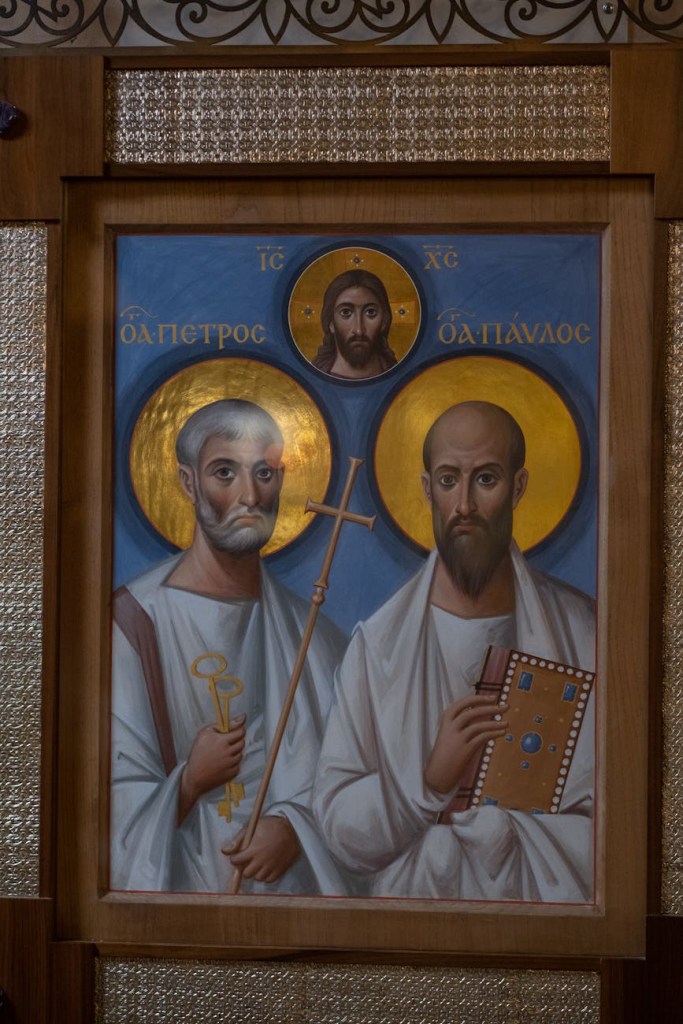
Initially, this is a bit cryptic, but makes more sense when you get down to verse 17 where we’re told to obey our leaders.
Here, however, the church is told to remember their leaders, those who spoke the word to them (notice the past tense).
The author is instructing the church to remember those who laid the foundations for their faith, the pioneering missionaries and apostles who first brought the Gospel to them and lived among them, setting the example for a life of worship and devotion to Christ. Remember them, and their way of life, and imitate them.
In a sense, this is a reminder to never let go of the pioneering spirit of the Gospel. If the Hebrews are to imitate those leaders, then surely laying down your life for the sake of the Gospel was part of it.
Keeping our connection to the apostles and first missionaries is part of a life of worship. Seeking ways to advance the Gospel, looking for opportunities to share the message of Christ, and inviting people to follow Jesus with you. This is what those leaders did, and we are to imitate them and live as missionaries and ambassadors wherever we are.
Why? Because Christ is the same then as he is now.
He still saves.
He is still the only way to to eternal life.
He is still the crucified and resurrected Lord.
He will still judge the world one day.
And as long as Christ remains the same, then his mission remains the same and the Great Commission remains the same.
As we partner with Christ in the work of the Gospel, He receives it as worship.
Verse 9-12: Do not be led away by diverse and strange teachings, for it is good for the heart to be strengthened by grace, not by foods, which have not benefited those devoted to them. We have an altar from which those who serve the tent have no right to eat. For the bodies of those animals whose blood is brought into the holy places by the high priest as a sacrifice for sin are burned outside the camp. So Jesus also suffered outside the gate in order to sanctify the people through his own blood.

One of the key ways we’re able to live lives devoted to Christ is by keeping to the pure and simple doctrines of the Apostles; the Gospels and the Epistles.
As soon as we venture into alternative sources of ‘truth’, special revelations, an over-emphasis on dreams and visions, or sectarian dogma, we open ourselves up to being deceived and led astray.
This is how Islam started, it’s how Mormonism started, it’s why Luther confronted the Roman Church and called them back to proper doctrine. The Church, however, refused to listen and continued to practice their greedy, pagan practices.
The writer of Hebrews is comparing the Gospel of Grace, ‘it is good for the heart to be strengthened by grace’, with the sacrificial system of the obsolete old covenant, ‘those who serve the tent’.
While the specific example in Hebrews is likely the Judaisers, those wanting to circumcise the Gentiles and force non-Jews to embrace observance of the law as part of their Christian conversion, the wider meaning today is that we are to be on guard against any use of scripture that attempts to pervert the Gospel of Grace.
How do we ensure we are not those who are led away? By knowing the truth for ourselves. Reading and meditating on the Gospel. Studying scripture in community, not just in the secret place. By listening, and catch this, to people we may not agree with. Why? To ensure we don’t build an echo chamber and surround ourselves with only those voices with whom we already agree.
Read and listen to both catholics and protestants, evangelicals and reformed, pentecostals and presbytarians. And if what they say does not line up with what is clear in the Gospel, shake the dust off and move on.
Verse 13-14: Therefore let us go to him outside the camp and bear the reproach he endured. For here we have no lasting city, but we seek the city that is to come.

In his sermon on the mount, Jesus said “Blessed are you when others revile you…. on my account”. In Luke 9:26 he said, “For whoever is ashamed of me and my words, the Son of Man will be ashamed of him when he comes in his glory and that of the Father and the holy angels.”
Peter denied Christ, and because of the mercy of God, he was reinstated and never denied him again. We too face the same temptations, the same fears, the same troubles… will we admit to belonging to Jesus when it might cost us?
To go ‘outside the camp’ was to not belong inside it. The refuse from the offerings were taken outside the camp, unholy and unclean. Likewise, Jesus, who became sin when we was nailed to the cross, was ‘outside the camp’. When we align with Jesus we must be willing to be treated as refuse by the world.
Consider the strong words of James,
“Do you not know that friendship with the world is enmity with God? Therefore whoever wishes to be a friend of the world makes himself an enemy of God.”
James 4:4 ESV
If we long to ‘fit in’ then we will resist going ‘outside’ the camp. If we long for acceptance with the world, we will turn aside from the acceptance of God.
Being willing to endure persecution, loss and suffering of various kinds, for the sake of Jesus, clinging to him, and refusing to deny him in either word or deed, this is acceptable worship to the Lord.
While I know the Lord loves it when we sing praise to Him, I get the feeling that those who refuse to recant their faith in the face of martyrdom are offering to the Lord something of far greater worth than a simple melody in the comfort of church auditorium.
Live outside the camp. Be unashamed. Make your faith obvious. Don’t shrink back. Go the bold.
Worship Jesus and reject the World.
And know that when you do, there is an eternal reward, in the eternal city, that will last infinitely longer than any prize the world could have offered you.
Verse 15: Through him then let us continually offer up a sacrifice of praise to God, that is, the fruit of lips that acknowledge his name.

Sing!! Finally!! It took a while but we made it – sing to the Lord!
I don’t even need to provide scriptures here, the entire book of Psalms is evidence enough!
Sing in private, sing alone, sing in the congregation. Sing with music, sing without it. Sing praises to God!
Don’t have a good voice? Sing!
Can’t stay in tune? Sing!
The scriptures never ask us to sing ‘well’ or ‘only if it sounds good’ – no, it simply says over, and over again, ‘sing to the Lord!’
Verse 16: Do not neglect to do good and to share what you have, for such sacrifices are pleasing to God.

Not all sacrifices have to be painful and expensive; do good, and share what you have.
The writer is not saying that to do good must involve sacrifice, but rather, he is saying that doing good to others replaces the sacrificial system as a way of doing something that pleases God.
Good deeds won’t save you, but I would question your salvation if you never do any good… and so would the James:
“What good is it, my brothers, if someone says he has faith but does not have works? Can that faith save him? …But someone will say, “You have faith and I have works.” Show me your faith apart from your works, and I will show you my faith by my works. You believe that God is one; you do well. Even the demons believe—and shudder!”
James 2:14, 18-19 ESV
Doing good is not what we do in order to be saved, it’s what we do as a result of being saved because this pleases God and we desire to please Him and this is what we were made for (Eph 2:10).
The world collects, the world hoards, and the world cares only for itself. Christians ought to share, distribute, and be generous with all that is entrusted to them.
When we share what we have, three things are happening.
- We are obeying this command in Hebrews and doing something that pleases God and acknowledges Him as Lord (that sounds like worship).
- We are demonstrating our trust in God as our provider, by not hoarding our wealth and building bigger barns (Luke 12:16-21), and loving our neighbours as ourselves.
- We are actively rejecting to worship Mammon, by demonstrating that our wealth and resources do not own us, but rather that we are stewards of that which God has entrusted to us.
When we share and do good, the Lord Jesus receives it as worship:
“Then the King will say to those on his right, ‘Come, you who are blessed by my Father, inherit the kingdom prepared for you from the foundation of the world. For I was hungry and you gave me food, I was thirsty and you gave me drink, I was a stranger and you welcomed me, I was naked and you clothed me, I was sick and you visited me, I was in prison and you came to me.’”
Matthew 25:34-36 ESV
Verse 17: Obey your leaders and submit to them, for they are keeping watch over your souls, as those who will have to give an account. Let them do this with joy and not with groaning, for that would be of no advantage to you.
The Hebrew Christians likely have new leaders, not those who laid the foundation that earlier they were instructed to ‘remember’ and ‘imitate’, but new leaders who have been entrusted with the job of shepherding the flock.
These new leaders are not here to provide new doctrines, but to preach the same doctrines already laid down. In doing so, they will ‘keep watch over your souls’. The use of the phrase ‘keep watch’ reminds me of the shepherds who stay out in the hills with their sheep to ‘keep watch’ throughout the night – it was their job to protect and guard the sheep from wild animals seeking to devour the sheep.
This is a big deal for leaders, knowing that they will be held accountable for how well they have cared for and kept watch over God’s people.
In Ezekiel 34 the prophet gives a scolding review of Israel’s caretakers, those entrusted to Shepherd the people of God, showing us that the motive and heart of the shepherd is meant to reflect the sacrificial love of the Father, and they didn’t have it.
What if you’re not a ‘leader’ though? As an act of worship to God, you should do all that you can to make the leaders job easier and joyful.
Let them lead you. But with what? The Gospel of Grace.
It is the Leader’s job to continuously point you back to the Gospel, both in and for every part of your life. That is precisely what every single Epistle in the New Testament does; points us back to Jesus and the grace afforded us through his death and resurrection.
Beyond this, as pastor John MacAurther said, the pastor has no authority in the life of a beliver beyond what scripture teaches. Only scripture has authority, and it is the pastor’s job to teach, preach and declare it boldly, cleary, plainly and with gentleness and grace.
Let them do this. Encourage them to do this. Submit to them as they do this, for this is good for your soul and pleases the Lord.
Verse 18-19: Pray for us, for we are sure that we have a clear conscience, desiring to act honorably in all things. I urge you the more earnestly to do this in order that I may be restored to you the sooner.

Finally, praying for your pastors, for leaders, for missionaries and for those who labour in the Gospel is an act of worship.
Why?
Because, when we pray for those whose work is the Gospel, we are confessing to God our belief in the importance and value of that work.
We pray for the things we value most. And when we pray for our leaders to succeed we are communicating to God the value we place on the Great Commission, and this pleases God.
It’s hard to believe a Christian can care about the Gospel if they never pray for its advancement.
This is worship.
Brotherly love, showing hospitality, showing concern and care for the persecuted and imprisoned, holding marriage in high honour, being content and refusing to love money, staying connected to the apostles and their teaching, guarding against weird doctrines and knowing the Gospel of grace more and more. Living outside the camp and rejecting the acceptance of the world, praising God with our lips, doing good, sharing what we have, obeying our leaders as they remind us of the Gospel and the Way of Jesus, all while praying for the advancement of the Kingdom…
This is worship.
In closing this verse-by-verse exposition of Hebrews 13, let’s receive the benediction the writer of Hebrews finishes with as we seek to live as those who worship Jesus Christ, in song, and in every other way that brings God pleasure;
Now may the God of peace who brought again from the dead our Lord Jesus, the great shepherd of the sheep, by the blood of the eternal covenant, [21] equip you with everything good that you may do his will, working in us that which is pleasing in his sight, through Jesus Christ, to whom be glory forever and ever. Amen.
Hebrews 13:20-21 ESV
Discover more from Seeds & Streams
Subscribe to get the latest posts sent to your email.
