In some Pentecostal and charismatic circles there is this belief that although Christians have received the Holy Spirit, there are ‘dormant gifts’ that cannot be, or are not being, accessed, used, or engaged with. According to this view, these so-called ‘dormant gifts’ need to be woken up, pluged in, and switched on… they require ‘activation’.
This ‘activation’ perspective says that a special person or action is required to ‘activate’ these gifts, someone needs to pray for you, anoint you, release something, unlock something, or get you to do something weird or unusual to ‘trigger’ an activation.
Advocates of this belief are convinced that some kind of button needs to be pushed for Christians to truly access what God has given them. But is this kind of ‘activation’ a Biblical concept or is it a modern idea taken from somewhere else? Is the need to be activated taken from scripture, or not? And why is it only healing and prophecy that seems to need activation, why not the gifts of helps, administration, mercy, or leadership? Is there a Biblical reason for this that we should lean into? If not, is the doctrine of ‘activations’ dangerous and unhelpful, with nefarious motivations lurking in the dark, or is it all just insignificant and of no consequence? Let’s discuss it:
Did Jesus “activate” his disciples?
When Jesus wanted to pave the way for his arrival in various towns and villages, he commissioned his 12 apostles, sending them out 2-by-2 and giving them authority to heal the sick, cast out demons, and proclaim that the Kingdom of Heaven was at hand.
And he called to him his twelve disciples and gave them authority over unclean spirits, to cast them out, and to heal every disease and every affliction… [then he sent them saying] And proclaim as you go, saying, ‘The kingdom of heaven is at hand.’ Heal the sick, raise the dead, cleanse lepers, cast out demons. You received without paying; give without pay.
Matthew 10:1 & 7-8
All Matthew tells us is that Jesus gave them authority, and Matthew was there as one of the 12, so he would know.
Matthew gives no description of a ceremony, of laying on of hands, of anointing oil, or of special items of clothing, tunics, scarfs, or mantles. These things may or may not have been involved, but we’re not told they were, so it’s safe to assume they weren’t, or at the very least aren’t important details; Matthew simply says that Jesus ‘gave them authority’.
Okay, but what about the other Gospels?
Mark 6:7 says [Jesus] called the twelve and began to send them out two by two, and gave them authority over the unclean spirits and Luke 9:1-2 it’s recorded that Jesus called the twelve together and gave them power and authority over all demons and to cure diseases, and he sent them out to proclaim the kingdom of God and to heal.
Mark, whose written account is based on the testimony and life of the Apostle Peter, unsurprisingly agrees with Matthew.
But does it mean what it plainly appears to be saying?
“When the plain sense of Scripture makes common sense, seek no other sense; therefore, take every word at its primary, ordinary, usual, literal meaning unless the facts of the immediate context, studied in the light of related passages and axiomatic and fundamental truths, indicate clearly otherwise.
Dr. David L. Cooper (1886-1965),
founder of The Biblical Research Society
Dr. Cooper’s wise and respected perspective quoted above has often been shortened to “When the plain sense of Scripture makes common sense, seek no other sense, lest it results in nonsense.”
Jesus didn’t do anything other than give them authority, most likely, he just said it.

‘Activate’ & ‘activation’ are words not found in scripture
When you conduct a simple word search in a Bible Study tool like Biblegateway.com it’s easy to discover that the English words ‘activate’ and ‘activation’ are not Biblical words. The only ‘translation’ that uses these words is the Passion Translation (which is not really a ‘translation’ but a sectarian paraphrase, not reliable for accurate expository Bible Study. You can read more about translations here in a previous article).
I searched the ESV, NIV, NLT, BSB, and others, and none of them have the words ‘activate’ or ‘activation’, but ‘The Passion’ (TPT) uses ‘activate’ 6 times. The TPT seems to be pushing language and ideas not found in scripture or the broader body of Christ or Church History. This is precisely why the TPT is considered ‘sectarian’ as it uses language and ideas that appeal only to a particular sect of Christianity, that is, language that is uniquely used only by a specific sect or brand of Christianity; charismatic buzzwords.
The problem with using words like this (or other buzzwords not in the Bible) to describe how Christians should expect to experience the things of God is that it draws more on culture and personal preference and not on scripture. The results are damaging, as we’ll discuss.
Using sectarian language tends to conform scripture to our context, preferred culture, and desires, instead of our culture, context, and desires being conformed to, and shaped by scripture.
The real question at hand is, ‘Who or what are we being shaped by; scripture or culture?’
And by culture I don’t simply mean the ‘world’, churches have culture too. Without making a value comment or critique, what culture do you think of when someone mentions Hillsong? Anabaptists? Catholic? High Anglican? Pentecostal? Quaker? All churches have unique cultures, and not all of it is shaped by scripture… as my dad always said, if you find the perfect church, don’t join it, you’ll ruin it!
No church or church culture is perfect, but we are called by Jesus to move towards that end, and he has gifted and graced each believer to contribute uniquely to the building up of the Church. But we won’t get there if we follow cultural ideas instead of Biblical ones. I digress…
Let’s come back to the issue at hand: God wants you to be active in his Kingdom.
God wants you to be active in bringing the culture of heaven to earth, and he wants you to be actively using your God-given gifts to contribute the ministry and mission of the Gospel. He wants you to be actively co-labouring alongside him in making disciples.
The Lord does want us to be active, but do we need to be ‘activated‘?
And is there really any problem with it anyway?
Let’s be good Bereans (Acts 17) and ask some questions: Is this idea of ‘activations’ how the Bible describes the gifts of the Spirit being used?
And are the Spiritual gifts of God dormant and ineffective without a special activation moment? Or moments?
My issue is not that I don’t like English words that aren’t in the Bible, I would have to read it in Greek and Hebrew if that was the case.
My issue is that I don’t like words that misrepresent what God meant, and therefore build inaccurate doctrine and expectations in the hearts and minds of believers which ultimately lead to deception and discouragement. Words matter, remember, it was Jesus who said not even one dot or iota would go missing from the law! (That means even the grammar matters in translations, not just the words – it all matters!)
This is the realm of Dogma; things that are treated like Gospel, even though they might be secondary issues of faith. Usually, most dogmatic issues can simply be a case of ‘each to their own’, but when a dogmatic belief hurts or hinders the church, by opposing scripture, it needs to be courageously, and humbly, addressed. Why? Because dogma that opposes the Truth is Heresy.
Simply put, words carry power.
God spoke words and the heavens and earth were created.
Jesus is the Word of God in flesh, so yes, words are powerful!
Words cultivate culture and form our beliefs, words articulate our paradigms and communicate our doctrines. Words matter because they inform our beliefs and ultimately our actions and therefore the very trajectory of our lives.
Ever had to activate a new account or subscription?
When you purchase a gift card from a shop, it remains worthless until you take it to the register and they ‘activate’ the card. The card itself has no inherent value, it must be activated externally.
When you sign up for a new subscription service, perhaps for Netflix or a weekly delivery like Dinnerly or HelloFresh, you sign up and they send you an email. For your subscription to be fully functional, you need to find the link in that email and click ‘confirm’ or… ‘activate’.
This kind of activation consists of a secondary action to validate a previous action or decision. Read that again.
Does the Bible teach that we need a secondary action to validate or make available to us the gifts that the Holy Spirit has already given?
Do we need to be activated?
Spoiler alert: I can’t see the evidence for it, but please drop some scriptural references in the comments below if you think otherwise, I’m open to being wrong if scripture says so.
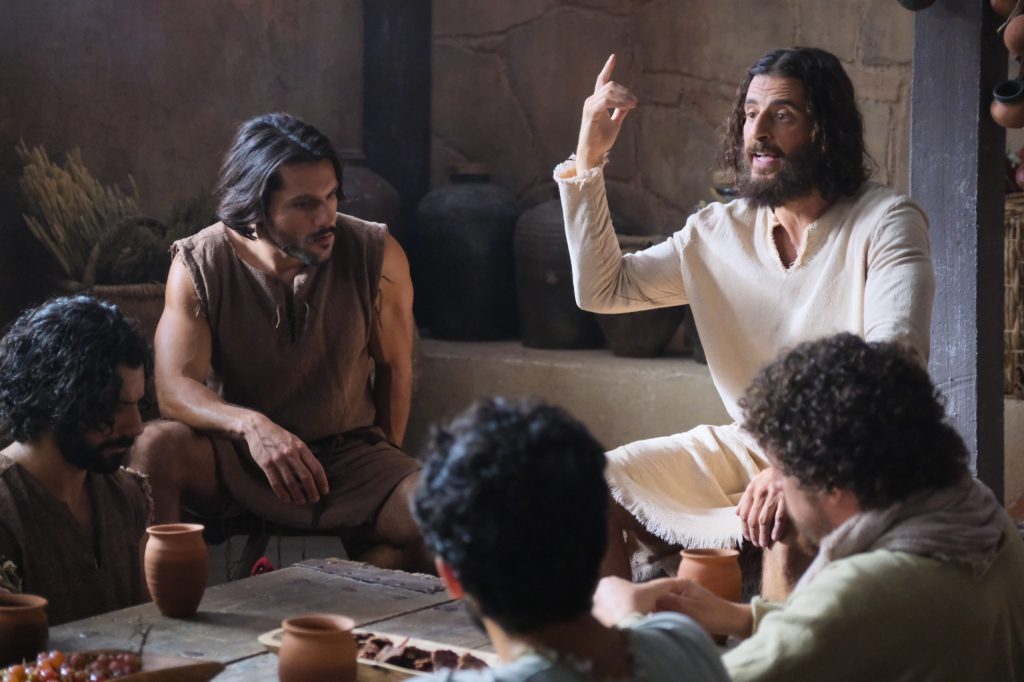
It’s interesting that the writers and directors of the hit TV series ‘The Chosen’, which, very creatively, retells the Gospel stories, chose to have Jesus giving his 12 disciples power and authority in a very low-key moment, sitting around the table while they ate and drank together. It just seemed to be a very Jesus-like thing to do.
In the scene, Jesus didn’t lay hands on them or anoint them, he simply told them, “I am giving you power and authority”.
What makes this especially interesting is that ‘The Chosen’ uses reputable Catholic, Evangelical and Jewish scholars as script consultants because while the show is highly creative in its retelling of events we don’t know about (eg, giving character’s background stories to help flesh out their humanity) they are also trying to stay as true as possible to what scripture does reveal.
While this retelling may not be exactly how it happened, it at least seems true to the details we are given in scripture, that in what appears to be a very low-key way, Jesus gave them authority.
If you need ‘activation’ what happens if you don’t get it?
Here is where the issue starts to truly become problematic; the issue of ‘applied logic’.
If I don’t get that confirmation email and validate my new subscription, my card won’t be charged and I won’t get access to the product or service I wanted.
If ‘activation’ is a real and necessary thing for my spiritual gifts, what happens if no one comes along and activates me? Does the gift sit dormant and inaccessible? Is that what God had in mind when he poured out his spirit?
Is the majority of the Body of Christ inactive because they’ve not been ‘activated’ properly?
The problem with ‘activation’ dogma is that it rebuilds the human priesthood and creates an intermediary between God and his people all over again.
Activation-dogma conditions believers into thinking they need a special man or woman of God to ‘click’ the email link for them.
In this scenario, the people of God look to pastors, prophets, teachers, special ministries, guest speakers, or elders to lay hands on them and ‘activate’ the gifts so they can use them.
In other words, believers are hamstrung and helpless waiting for the special sauce that someone else has to get them moving in the grace and gifts God has given them.
Activation dogma believes most Christians are helplessly flailing about waiting for a guru to ‘activate’ them because the Holy Spirit didn’t get the job done.
Applied logic makes this position presume the Holy Spirit was not enough and that we need a second ‘touch’. It creates proud gurus and co-dependant Christians.
Consider Pentecost, where was the Apostle Peter’s second touch? Who activated him to preach? No-one. The Spirit came, Peter was bold, and he preached up a storm!

What about the laying on of hands?
When some of the apostles went to Samaria they laid hands on the people in order for them to receive the Holy Spirit (Acts 8:14-17). We see Paul do the same in Ephesus (Acts 19:1-7). These moments of impartation and human involvement were indeed special, they were remarkable and we love to see them!
We also see the Holy Spirit fall upon the believers in Cornelius’ house while Peter is speaking to them without anyone laying their hands on them or even praying for them (Acts 10:44-46).
These examples show us that God does not want us to use rules and formulas, he told us to preach the Gospel, make disciples, and love one another.
The other thing about these examples is they all involve new believers receiving the Holy Spirit as brand new converts, they’re not long-term believers, who have already received the Spirit, needing to be activated; they are brand new believers needing to be filled/baptized in the Holy Spirit for the first time.
These examples are about the initial receiving of the Holy Spirit, not some secondary activation. It is certainly Biblical to lay hands on new believers and pray for them to receive the gift of the Holy Spirit!
Fan into flame vs activate your gift
When Paul wrote his first letter to Timothy, the Apostle told his young leader not to neglect the gift of God. I can only assume that perhaps Timothy was getting lazy or apprehensive about using his gifts, even fearful. Whatever the case, Paul was concerned that Timothy was on the verge of neglecting what God had given him. In his second letter to Timothy, Paul urged the young man to ‘fan into flame’ the gift he received.
Do not neglect the gift you have, which was given you by prophecy when the council of elders laid their hands on you…
fan into flame the gift of God, which is in you through the laying on of my hands…
1 Timothy 4:14 & 2 Timothy 1:6
In these instances, we get hints that the gift Timothy has, the gift Paul is encouraging him to fan into flame and not neglect, was something Timothy received during a kind of presbytery or prayer moment when Paul and other elders laid hands on him.
This, again, is a great example of how God often gives the Holy Spirit, through the laying on of hands.
This is “the gift of God” that Timothy received, the Holy Spirit, and is most likely the one and the same event that Paul is referring to, not two separate events. But notice Paul doesn’t offer any help nor does Paul instruct Timothy to do anything to activate his gift, other than…
Get on with it!

Notice, however, that Paul does not infer that Timothy needs a second presbytery, nor does he recommend a second session with the elders.
Paul now expects that since Timothy has already received the gift of God, Timothy now has all he needs to be fanning that gift into flame and actively using his gifts as empowered by the Spirit.
Timothy was given an encouragement and a reminder, not an activation.
Paul didn’t come to Timothy and lay hands on him again, nor instruct him to get prayer from a visiting ministry, he instructed him to pull himself together, dust himself off and remind him of what he had already received and ultimately told the young man to get on with it!
We require obedience not activation
If, like Timothy, you already have the Holy Spirit, the beautiful gift of God, then you do not need to be activated, you need to be obedient.
Waiting for activation is an excuse for being fearful, lazy, full of unbelief and timidity. Paul told Timothy that he didn’t receive a spirit of fear, timidity or apathy, but of Love, Power and Self Control. If any activating needed to be done, Paul believed it was within Timothy’s reach to do it himself.
If any activating needed to be done, Paul believed it was within Timothy’s reach to do it himself.
Timothy needed to get on with it; so do you, and so do I.
Jesus gave us his Spirit to empower us to obey his commands, follow his voice and bear witness to the Gospel (see John 14 & 16, Acts 1, Romans 12 & 1 Corinthians 12).
The only other thing we need is to muster up a little faith, a little courage, and obey. How? Meditation of the love of Christ fuels our obedience.
“If you love me, you will keep my commandments. And I will ask the Father, and he will give you another Helper, to be with you forever, even the Spirit of truth, whom the world cannot receive because it neither sees him nor knows him. You know him, for he dwells with you and will be in you. “I will not leave you as orphans; I will come to you. Yet a little while and the world will see me no more, but you will see me. Because I live, you also will live. In that day you will know that I am in my Father, and you in me, and I in you. Whoever has my commandments and keeps them, he it is who loves me. And he who loves me will be loved by my Father, and I will love him and manifest myself to him.” (John 14:15-21)
Notice the way Jesus speaks of the gift of the Spirit and our obedience to his commands in such an intermingled and relational way? The activation we need has already been done the moment you were born again and filled with the Holy Spirit.
there is one God, and there is one mediator between God and men, the man Christ Jesus, who gave himself as a ransom for all
1 Timothy 2:5-6

One mediator; Jesus christ
Under the Old Covenant, the priests acted as the go-between for God and the people. The priests were mediators, peacemakers, intermediaries, and advocates standing in the gap that existed between God and the people.
Jesus closed the gap by becoming the ultimate mediator on our behalf when he died on the cross as a ransom for our sins.
Now, because of that, we can approach the throne of God ourselves! Read that again – you can approach God on his throne yourself! (Hebrews 4:16).
The gap is gone!
The need for mediation is resolved and removed!
We no longer need a human priest, pastor, prophet, teacher, or evangelist to act on our behalf, Jesus has done it all! And he is our Great High Priest Forever – we need no other!
What’s more, Jesus then sent us the Holy Spirit whom he called… {drum roll}… our advocate!
And I will ask the Father, and He will give you another Helper (Comforter, Advocate, Intercessor—Counselor, Strengthener, Standby), to be with you forever
John 14:16 – amp
If Jesus is our Mediator and the Holy Spirit is our Helper why would we look to another?
Teaching believers that a secondary (or third or fourth…) “activation” is something they need, keeps the people dependent on the wrong mediators and keeps those who teach such things in high demand and high esteem. Such ‘teachers’ are peddling what God gives freely, and it’s not okay.
To be sure that there was no confusion, Jesus restructured the priesthood for the New Covenant.
There is no longer a special class of priest that mediates for us, as we’ve seen, Jesus is our Great High Priest and mediator (Hebrews 4:14).
But to drive the point home even further he elevates every single believer into the office of priest. We are priests in a kingdom of priests and we’re each able to stand before the Lord because of the work of our Great High Priest Jesus!
But you are a chosen race, a royal priesthood, a holy nation, a people for his own possession, that you may proclaim the excellencies of him who called you out of darkness into his marvelous light (1 Peter 2:9).
You don’t need another priest, you have one and you are one, what you and I both need is the courage to obey, to not neglect the Gift of God but to fan it into flame and get on with it.

Please, no… don’t take my crutches!
The truth is that we are often all too eager to embrace anything that excuses our laziness and disobedience; I know, me too…
Like Adam, we like our fig leaves right where they are.
Deep down, we know we don’t need an activation, but by ‘believing’ it we can lie to ourselves about why we’re not actively serving the Lord with the grace and gifts given to us.
We would rather wait for the special sauce than roll up our sleeves and put our hands to the plow. ‘Oh, I can’t serve God because I don’t have gift x and gift y’, or ‘if only I was anointed, like that special Christian over there, then I could really serve God!’ It’s all a lie.
Either we were never told that we received the Holy Spirit, or we’re just not that keen on living as mission-focused, spirit-empowered, followers of Jesus; we’ve settled for religion.
We don’t want to abandon our belief in ‘activations’ because they’ve been a neat little set of crutches to lean on; “If I’m not being active in ministry or some type of gospel advancing work, it must be the preacher’s fault, not mine – I’m not equipped, I haven’t been… activated properly.”
We don’t suffer from unbelief half as much as we suffer from disobedience, or, as may be the case here, ignorance. We can’t live in response to a truth we’ve never been told.
Picture this: every Christian has been given the Advocate. The same spirit that raised Christ from the dead. The same spirit that hovered over the deep darkness at the beginning of creation. The same spirit that descended like a dove on Jesus, and tongues of fire on the disciples. You, me, them, us… every adopted child of God has this Holy Spirit.
Imagine a Church full of Christians who knew and lived as though they already had everything they needed to do every good work Christ has prepared in advance for them to be part of?
“For we are his workmanship, created in Christ Jesus for good works, which God prepared beforehand, that we should walk in them.”
Ephesians 2:10 ESV
“You, however, are not in the flesh but in the Spirit, if in fact the Spirit of God dwells in you. Anyone who does not have the Spirit of Christ does not belong to him. But if Christ is in you, although the body is dead because of sin, the Spirit is life because of righteousness. If the Spirit of him who raised Jesus from the dead dwells in you, he who raised Christ Jesus from the dead will also give life to your mortal bodies through his Spirit who dwells in you.”
Romans 8:9-11 ESV
We don’t need activating; we need convincing that the Gospel is true. Christ is in you, the hope of Glory.
Why do some pastors do ‘activations’ then?
There are a few possible explanations
- They were raised that way and never questioned it: A lot of well-meaning pastors and leaders may have grown up with spiritual activations being ‘a thing’ and never had cause to question it. They followed the tradition of their fathers and carried on doing what had always been done. This doesn’t excuse it, but it may explain it.
- They are frustrated and don’t know how else to get people engaged in the ministry: It’s possible that some pastors just desperately want to see every Christian active in using thier gifts that they have bought into the lie that says ‘activations’ are the smoking gun to solve the issue of apathy in the church. Instead of reminding their congregation of the wonder and beauty of the Gospel and calling the church to labour with God in making disciples, they opt for a kind of manipulative-motivation method. The heart is good, the method is wrong, and people get hurt.
- They love the control: Let’s be honest, there are some church leaders who simply love the control they have over people. The more you need to look to them for anything spiritual, the more important, powerful and ‘anointed’ they feel; they serve their ego, not God.
- They prefer power over process: These types of leaders would rather pray and wait for God to ‘move’ than to simply invite someone over for dinner. They want signs and wonders, not blood, sweat and tears. They want to see power manifestations, miracles and supernatural expressions of the Holy Spirit, but show little interest in the long, slow burn of living on mission. They train their church to do likewise – everyone is on edge waiting for the next revival to break out, but few are actively making disciples or washing feet.
It might be a combination of these things, but it mostly comes down to what we believe concerning what the scriptures say. Many simply prefer their culture, love their way of doing things, and have seen fruit or results so assume it to be true, so they go to the scriptures only seeking to confirm their opinion.
But as with all things, we must start with scripture and build our opinions on what it clearly says.
For pastors and church ministers, the temptation to love ‘activations’ is strong because it feeds our ego, strokes our pride and makes us feel needed, important and powerful – as ministers we need to repent from self-serving methods of ministry and equip the church with the Gospel; with Truth.
The problem is not activation, but whether or not the people of God are active in using what the Lord has given them.
A big part of the minister’s job is to help God’s people see what they already have, and then to put a rocket behind them with relentless encouragement and support.
Consider these direct, straight to the point and easy-to-understand instructions from scripture:
- Jesus came and said to them, “All authority in heaven and on earth has been given to me. Go therefore and make disciples (Matthew 28:18-19)
- Having gifts that differ according to the grace given to us, let us use them… (Romans 12:6)
- As each has received a gift, use it to serve one another… (1 Peter 4:10)
Go and make disciples, use your gift, and serve one another. It might not be easy, but it’s certainly not complicated.
What about prophets, isn’t it their job to ‘activate’ us?
I have heard this said, but I don’t agree with it for several reasons:
Firstly, because of all I have written above, there is no scriptural need for secondary activations.
Secondly, I don’t see evidence in the New Testament of Prophets having this role. Any time I have read or heard a modern day ‘prophet’ saying otherwise the only evidence they give is anecdotal and subjective. I have never heard them make their case with New Testament scripture.
I could be wrong, but as far I can see there is no New Testament prophet recorded doing an ‘activation’.
No example, no pattern, no mandate.
Today’s ‘prophets’ are not the intermediaries many presume to be. They are heralds, announcers, those called to point to God, call His people to holiness and give words of encouragement, exhortation and strength, giving words of knowledge and wisdom from the Spirit of God in order to build people up. A prophet ought to inspire the people into greater intimacy with Jesus.
Prophets also warn us of future challenges as Agabus did in Acts 11, so we can prepare to face them with courage, faithfulness, and generosity.
Prophets encourage and uplift, pointing us towards Jesus and the coming of his Kingdom, prophets see what God is doing and then equip the church with revelation and preparedness so we can partner with the Holy Spirit. Prophets with integrity are those who have a proven track record, yet they also demonstrate transparency and humility when they miss the mark and get it wrong, after all, they are only human.
I can’t see anything in The New Testament that shows a prophet ‘activating’ believers. They might train and teach the church how to hear God more clearly, and how to operate in prophetic gifts like words of knowledge or encouragement, they might write songs or speak to us concerning the dreams and visions the Lord has given them, or help us to interpret what God has shown us, but their role is to spur us on, cheer us on, tell it like it is and not spare our feelings so as to equip us with mature kingdom thinking that propels us to get on with it!
(SIDENOTE: I know some people might use the word 'activation' when calling their listeners to a moment of response or action. Such preachers are trying to get their people to make decisions to get active in the life of faith. While I disagree with the use of the word 'activation', as I think it's misleading for all the reasons above, I recognise that there are some who use it with a different meaning in mind. If you're one of these people, perhaps you might consider what words would better describe what you're trying to achieve without leaving the door open to misinterpretation or misrepresentation)
Say it differently
The issue in a lot of cases is more about the words we use than the theology we hold. Those who use ‘activation’ when talking about praying for people to comprehend the gift and power of God given to them, like Paul did in Ephesians, would unlikely deny the priesthood of all believers, nor would they affirm that Christians need a special, secondary or external “activation” in order to use what God already gave them. So what else could we say? What language would best reflect the biblical position on spiritual gifts and the minister’s desire to exhort and encourage believers to get on with it?
Start using what you have.
Use the gift. Fan it into flame!
Do the good work prepared for you.
Be obedient to the leading of the Spirit. Be bold!
Repent of apathy and pursue a lifestyle of faithful service.
There are many ways to say what needs to be said to stir up faith in the body of Christ.
What if you knew you were already ‘activated’?
Think about it like this for a moment, what if the gifts you have were already charged, loaded, switched on, and ready to leverage for the Kingdom of God?
How would you live?
What would you do?
How and what would you give if you had the gift of generosity?
Who would you encourage and how would you do it if you had the gift of encouragement?
What if you knew you had the gift of hospitality, service administration, or leadership?
What if you knew you were able to operate in words of knowledge? What about Prophecy? Healing? No ‘activation’ required, just a life of active obedience and faith.
What if you knew that failure wasn’t nearly as concerning as disobedience?
What if the gift of God was already yours, no activation required?
You already have the authority and the position, you already have the role and the responsibility… God already has good works of the Kingdom prepared for you to do, so how will you, and I, stop waiting for an activation and… get on with it?
Discover more from Seeds & Streams
Subscribe to get the latest posts sent to your email.
