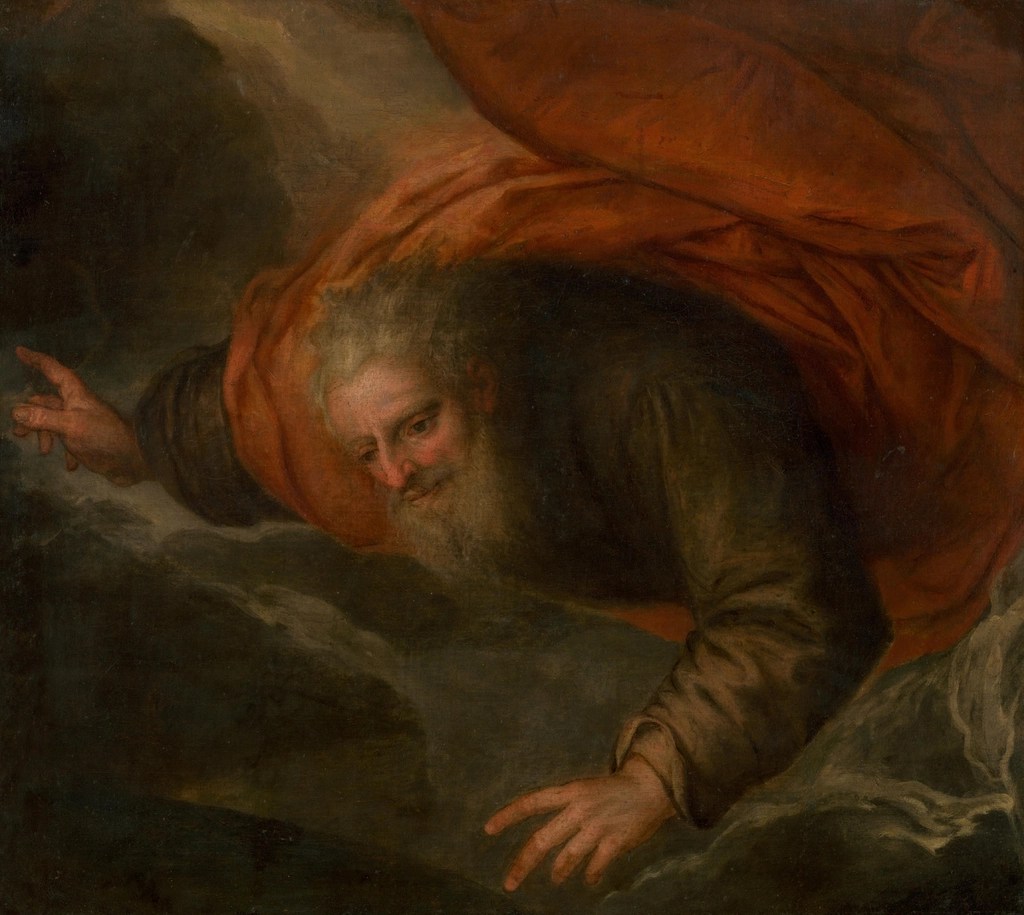
I remember expecting my understanding of God as my Father to be radically impacted when my first child arrived. And it was. Something was unlocked within me when I held my first child, and when we took her home, and even more so over the years as our family continued to grow. Bit by bit I was starting to understand what it might mean to be loved by my God, my Father.
‘Father’s Day’ is fast approaching, so what better time to consider the love of God the Father; Our Father, who art in heaven…
God is a father

The message that ‘God is a Father’ is the very scandal that led to Jesus being crucified. The Jews knew that to claim to be the Son of God was synonymous with claiming to be God.
The Jews picked up stones again to stone him. Jesus answered them, “I have shown you many good works from the Father; for which of them are you going to stone me?” The Jews answered him, “It is not for a good work that we are going to stone you but for blasphemy, because you, being a man, make yourself God.” – John 10:31-33 ESV
The notion of God having children was blasphemy to the Jews, they had no grid of reference in their legalistic minds for the possibility of a relational, loving father in heaven. Many people today are still just as offended that God could be treated so casually, so familiarly. In their minds, if they even believe in God, God is untouchable, high above, out of reach, seated on a golden throne in an ivory tower where mere mortals cannot get close to him. But this is not the view of God that Jesus, the incarnation of God, came to reveal.
Whoever has seen me [said Jesus], has seen the Father. How can you say, ‘Show us the Father’? Do you not believe that I am in the Father and the Father is in me? The words that I say to you I do not speak on my own authority, but the Father who dwells in me does his works. Believe me that I am in the Father and the Father is in me, or else believe on account of the works themselves. – John 14:9-11 ESV
The words and works of Jesus reveal to us the heart of the Father. As we study Jesus’ character, his parables, his teaching and as we observe his actions and mannerisms, we see the Father being revealed.
Perhaps the most dramatic story Jesus told that revealed the Father is the famous parable of the man with two sons, also known as the parable of the Prodigal Son.
For an absolute masterclass on this parable I highly recommend Timothy Keller’s book, ‘Prodigal God‘

You can read the full account of the parable in Luke 15, where Jesus weaves together one of the most famous teachings in history. The story is of a man with two sons; the younger son demands his inheritance early, effectively saying to the father “You’re dead to me, all I want is your stuff”. The father consents, amazingly, and we see the younger brother sell his share of the estate and leave home in search of the party life while the older brother stays home.
The father’s heart must have been shattered.
This young son had done the most awful thing. You can almost feel the anger in the crowd of people listening to Jesus, for they all understood the wickedness of this young son in dishonouring the father so blatantly.
If you know the story, then you know that eventually, the son returns, tail between his legs, hopeful that he might be able to get a job working as a servant in his father’s house, for he had now lost everything, he was homeless and broke. One can only imagine him rehearsing his apology over and over for days and days as he travelled home from the distant country he had gone to. His nerves and anxiety must have been going crazy, biting his nails, grating his teeth and fretting like an animal caught in a trap.
The crowd listening to Jesus must have been on the edge of their seats! “oh boy, he’s going to get it when he comes home! Just wait til the Father sees him coming!” The expectation was of condemnation, rebuke and rejection… “how dare you come back here!” Surely this was not going to end well for the young son.
Part of Jesus’ genius is revealed in Luke’s description of the crowd. At the beginning of Luke 15, when this body of teaching begins, Luke tells us: Now the tax collectors and sinners were all drawing near to hear him. And the Pharisees and the scribes grumbled, saying, “This man receives sinners and eats with them.” – Luke 15:1-2 ESV

Jesus knows who he is speaking to. There are those religious people who judge sinners, looking down on them from their high places of morality and duty. Then there are the sinners and tax collectors, those who likely feel like they too have behaved dishonourably and lived a wasteful life much like the younger brother in the story. The Pharisees are likely filled with righteous anger and zeal, waiting to hear Jesus condemn the young son as he returns to the Father’s house. Meanwhile, the sinners and tax collectors are likely biting their own nails, wondering if there is any hope left for them.
And this is precisely the point of confrontation and tension Jesus means to bring us to.
What will happen next!? The questions the crowd would have been asking themselves would have been wild! Remember, they hadn’t heard the ending yet!
Sometimes it can be hard for us to enter into the tension Jesus intentionally and masterfully creates with his teaching because we know the rest of the story. But I can imagine Jesus using a very pregnant pause, long and awkward, giving everyone time to truly wrestle with their own questions about who God is: What is the Father’s heart really like? Is God like us? Is God harsh and waiting to crush those who mess up and offend his holiness? Is he seated in a tower, out of reach, out of touch, unmoved by our pains and failures? Or is it possible that God is better than we ever imagined?
Even if you know the ending, try to approach this as if you do not.
[The younger son said to himself] I will arise and go to my father, and I will say to him, “Father, I have sinned against heaven and before you. 19 I am no longer worthy to be called your son. Treat me as one of your hired servants.”’ 20 And he arose and came to his father. But while he was still a long way off, his father saw him and felt compassion, and ran and embraced him and kissed him. 21 And the son said to him, ‘Father, I have sinned against heaven and before you. I am no longer worthy to be called your son.’ 22 But the father said to his servants, ‘Bring quickly the best robe, and put it on him, and put a ring on his hand, and shoes on his feet. 23 And bring the fattened calf and kill it, and let us eat and celebrate. 24 For this my son was dead, and is alive again; he was lost, and is found.’ And they began to celebrate. – Luke 15:18-24
It’s incredible! Right!?
The Pharisees and sinners alike would have all had their jaws on the floor – no one was expecting that! Jesus showed the Pharisees that God is more concerned with loving his wayward children than with punishing them. The father longs to have his lost children come home and is willing to endure great personal costs to ensure it is possible.

The sinners present could hardly believe their ears either! The God of Abraham, Isaac and Jaboc wants to embrace them and love them like a Father. What’s more, like a father who is willing to endure public humiliation and scorn for the sake of embracing his son. For you see, patriarchs did not run anywhere other than into battle; they walked, with dignity, and never lifted their skirts. This was scandalous and the whole town would have been talking, but this Father could care less, for his son who was dead is now alive!
The best robe (which almost certainly must have belonged to the Father) is thrust upon him, for the Father does not want his son to approach the house improperly dressed, so he covers him with his own covering, his own glory and righteousness.
This father gives him a ring, a signet ring with the father’s authority and name which functioned as the Father’s signature or a family credit card; the scandal of love continues!
Shoes on his feet, for in the ancient world servants wore no sandals, but only members of the household. The father would not allow his son to take another step with the mindset of earning his way back into the family or working as a slave to pay off his debts; he was a son!
We could spend days exploring the depths of what Jesus is revealing to us here.
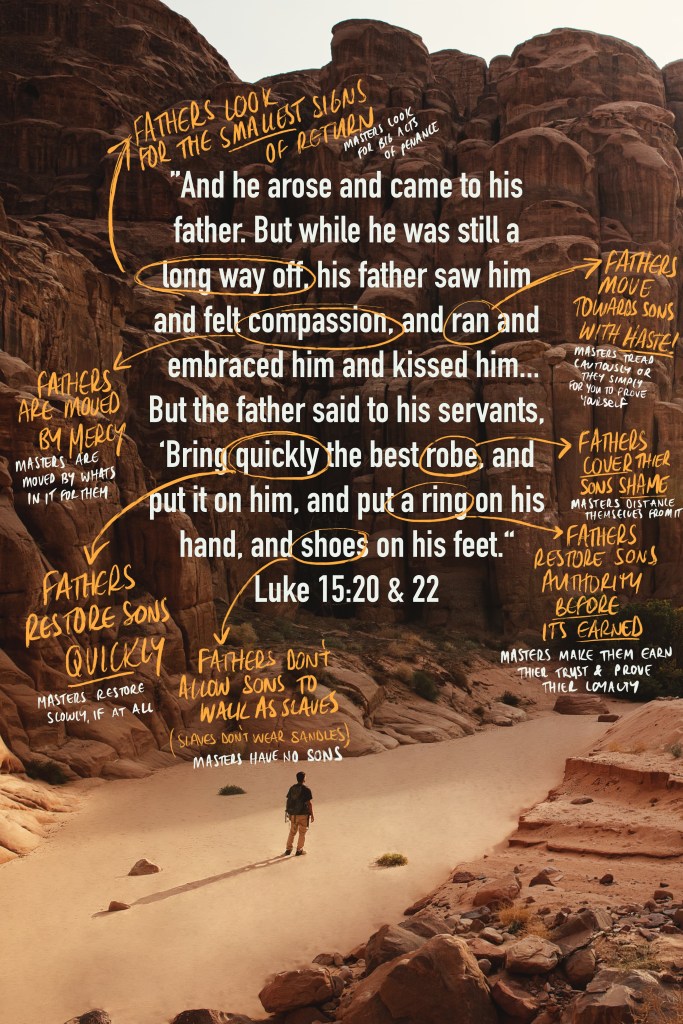
For the sake of time then, here are a few simple observations we can make about the heart of the Father, observations that are meant to help us see God more clearly, but also, are meant to shape the way we father those in our care, either literal sons and daughters or spiritually those whom we are leading and making into disciples.
Since we are welcomed home as sons and not slaves, I thought it would be helpful to compare the father’s actions and heart, to that of a ‘master’.
- a long way off: The Father looks for the smallest signs of return, whereas a Master looks for big acts of penance.
- Fathers are willing to accept even the smallest token of repentance and change in their children, willing and wanting for any opportunity to restore, strengthen and maintain intimacy with their children.
- Masters want respect more than affection, so they look for big signs of change. Masters are insecure, looking to guard themselves and protect themselves from being harmed or taken advantage of. Fathers are willing to risk it at even the smallest sign of change.
- compassion: When the father saw his young son returning, his natural response was mercy; not judgement.
- The father longed for restoration more than restitution, he desired mercy not sacrifice. The father felt compassion, this was his emotional state when he saw his son.
- Masters are moved by what best serves them. They value productivity more than accommodating the uniqueness of their children. Fathers are moved by mercy, Masters are restrained by self-presevation.
- ran: Fathers take the initiative to move towards their sons with haste, whereas masters tread cautiously as they wait for their son to prove themselves.
- Fathers do not care what others think, and will endure public humiliation and scorn if they must, for their heart is set on being restored to their son as soon as possible.
- Masters wait, cynical and cautious, looking for proof of change and ‘genuine’ repentance.
- Fathers run to their sons, masters wait for them.
- quickly: The father orders the servants to ‘quickly‘ bring the robe, ring and sandals. Fathers seek to restore and reinstate quickly, knowing it is risky, they believe the best and accept the risks (just as Jesus reinstated Peter after his denial).
- Fathers seek to bring sons back in quickly, before the other sons or servants can have a say in it.
- Masters restore slowly, after a time of testing, waiting to see if their son is deserving of regained trust.
- Fathers trust quickly, masters slowly, if at all, out of fear they might get hurt or cheated again. Fathers know the risk, and believe that not trusting is a greater risk.
- robe: The father covers his sons shame, masters distance themselves from it to avoid guilt buy association.
- Fathers risk guilt by association as losing association is worse.
- Fathers cover their sons shame, instead of exposing it, and they do so at great personal cost.
- Masters are not willing to make personal sacrifices to secure the son’s reputation, letting the son stand on their own two feet instead.
- Fathers give the best for their sons who deserve the least, Masters only ever reward those who are most productive in serving the master’s interests.
- ring: The Father shares his authority before his son can earn it
- The Father does not make his son jump through hoops, for the authority he gives is a gift that cannot be earned.
- Masters hold their cards close to their chest, controlling as much as possible they share the least amount of authority they can.
- Fathers trust their sons with an almost foolish level of confidence, giving away authority that is far beyond what has been earned. Masters make their sons earn everything, keeping any authority given on a string that can be pulled back in at any minute.
- Fathers believe in their sons, Masters continuously second-guess them.
- shoes: Fathers don’t allow sons to enter their house as slaves.
- A father addresses the son outside the house, ensuring he is appropriately dressed before entering the house; he is a son, not a slave.
- Fathers put their sons to work, but always as sons, never as slaves being forced, or as servants trying to earn their acceptance.
- Masters…. masters have no sons, only slaves and servants.
For Jesus to infer that God is our Father, and that he is like the father in this parable is mind-boggling. Every part of me wrestles with this, especially with the fathers extreme generosity and ready willingness to trust and empower his sons without vetting them or getting them to prove themselves or earn anything. All that the young son received is by virtue of the Father’s love and kindness, his mercy and willingness to risk personal pain and loss for the sake of his son.
This is the kind of Father we call on and run to in prayer.
This is the Father we rely on and cling to when we mess up and fail.
This is the acceptance and mercy we can expect.
This is our Father, who lives in heaven. Holy is his name.
This is who he is and it’s who he wants us to be like.
He is the bar that is set for us as Fathers and leaders. He wants us to be with him, so we would become like him, loving our own children as he loves us, and making disciples of those around us in the very same way.
As you meditate on the Father’s love, and the challenge to love like the father, consider the words from this beautiful song, How deep the fathers love:
How deep the Father’s love for us,
How vast beyond all measure,
That He should give His only Son
To make a wretch His treasure.
How great the pain of searing loss –
The Father turns His face away,
As wounds which mar the Chosen One
Bring many sons to glory.
Behold the man upon a cross,
My sin upon His shoulders;
Ashamed, I hear my mocking voice
Call out among the scoffers.
It was my sin that held Him there
Until it was accomplished;
His dying breath has brought me life –
I know that it is finished.
I will not boast in anything,
No gifts, no power, no wisdom;
But I will boast in Jesus Christ,
His death and resurrection.
Why should I gain from His reward?
I cannot give an answer;
But this I know with all my heart –
His wounds have paid my ransom.
The Father was willing to suffer, be humiliated and pay the full ransom to make it possible for us to come home, to receive the Father’s best robe on our back, ring on our finger and sandals on our feet.
May we run to the father, as he runs to us, and may we in turn run to our sons and daughters, both in the spirit and the flesh, with arms of mercy and grace, ready to sacrifice all that we must to bring them home into the Father’s house. Amen
Discover more from Seeds & Streams
Subscribe to get the latest posts sent to your email.
